Welcome to Resonance Quantum Theory
Reality balances individuality against unity.
What persists must remain itself, while still fitting into its surrounding resonance space.

Resonance Quantum Theory (RQT)
RQT begins with a simple assumption:
Everything physical is resonance.
Particles, photons, fields and forces are not treated as separate fundamental categories, but as different expressions of resonance structure. What appears to us as matter, light or interaction is described as resonance activity becoming stable, moving, coupling or failing to close.
- Matter is resonance: particles are stable resonance identities.
- Light is resonance: photons are propagating resonance structures.
- Forces are alignment effects: attraction and repulsion appear when resonances seek, resist or miss closure.
- Stability is closure: an identity persists by becoming partly enclosed from the surrounding resonance space.
- No identity is fully isolated: every stable structure keeps residual external resonance abilities.
- The universe is layered closure: open and closed resonances form a hierarchy from base units to atoms, molecules and fields.
- Persistence is optimization: what exists is what found a resonant way to remain.
RQT therefore describes the observable universe as an increasing hierarchy of resonance identities: some open, some closed, some only partially enclosed, all interacting through their remaining resonance abilities.
The Roton Quantum Model (RQM) begins where this closure becomes dimensional and geometric. It represents resonance identities as rotating, mutually enclosing structures and translates resonance closure into three dimensional spatial form. As long as the 3D projections allow or rather are forced to be specific enough when an enough localized probe appears.
Scientific paper on Resonance Quantum Theory - read↗
Welcome to the Roton Quantum Model - a rotational resonance framework
QRO Quantum Resonance Ontology: The ontological foundation of resonance space and its spatial projection.
RQT Resonance Quantum Theory: A resonance-based framework in which physical phenomena emerge from the dynamics of coupled resonance structures.
RQM Roton Quantum Model: An intuitive realization of RQT based on interacting Roton resonance channels.
Join us in exploring physics intuitively, from photon entanglement to the filaments of the universe.
This site presents Resonance Quantum Theory (RQT) and its Roton Quantum Model (RQM), a resonance-based framework for understanding and exploring the emergence of matter, radiation, and interactions as a hierarchy of coherent resonance structures.
Rather than starting from particles and forces as fundamental entities, the framework investigates how physical phenomena may arise from resonance structures and their interactions. Its goal is to provide an intuitive perspective on physics, connecting concepts from quantum entanglement, photons, and atomic structure to galaxies and the large-scale architecture of the universe. By applying a common set of principles across scales, the framework seeks to provide a unified and intuitive view of physical phenomena.
In short:
Physics may be describable as a hierarchy of phase-distribution networks whose stable structures emerge from the continual accommodation of phase mismatch across coupled resonance channels of different resonance spans.
But let’s start from the beginning.
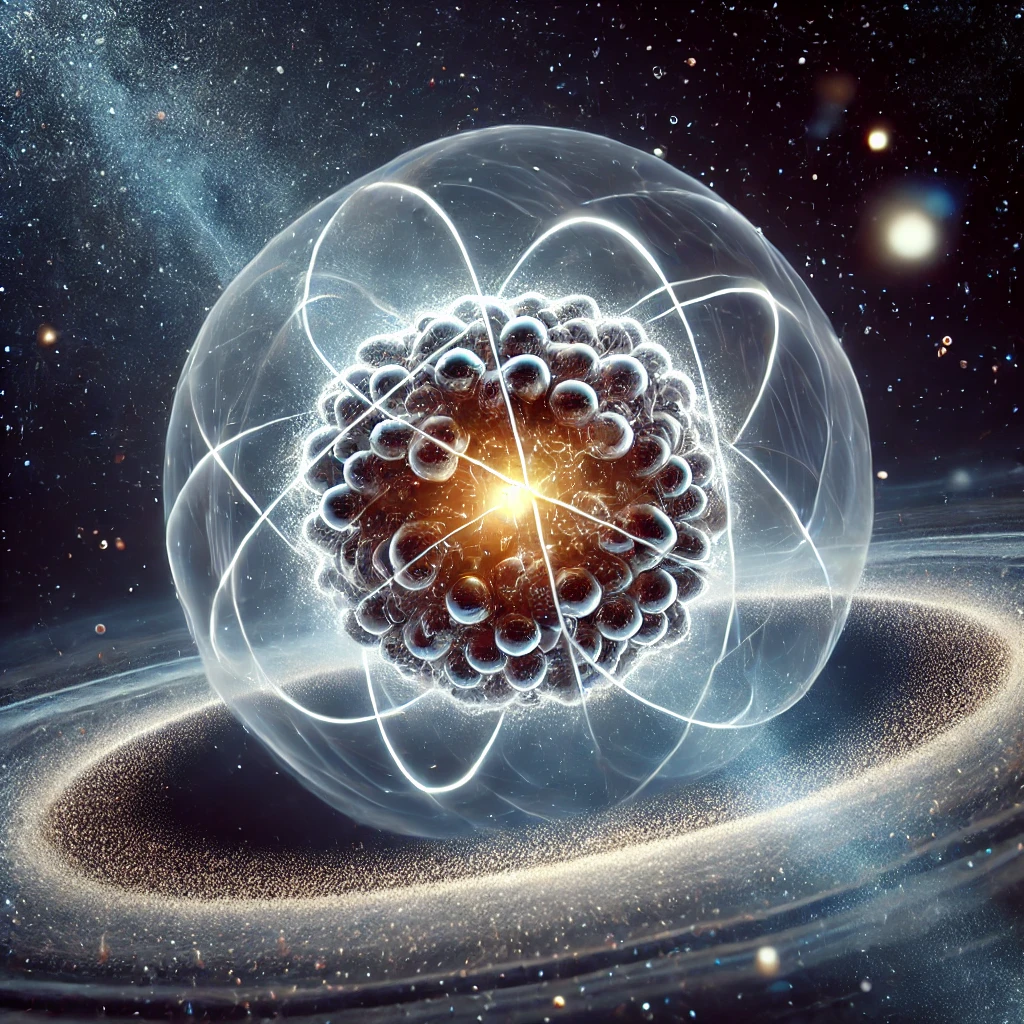 How does quantum entanglement create our world?
What happens when energy rotates around its own past and future?
Join us in exploring a conceptual universe of intuitive ideas, emerging structures, and surprising connections across physics.
Article: Critical Assessment of the Roton Resonance Model - read↗
Paper: Concept Paper of the Roton Resonance Model - read↗
Visual: Visualization of the RQM hierarchy (spoiler) - view
The Quantum Resonance Ontology of RQT
Resonance Quantum Theory proposes that physical reality is fundamentally a world of resonance relations, not a collection of objects located in a pre-existing three-dimensional space.
At its fundamental level, RQT describes resonance-capable nodes that can participate simultaneously in multiple coherent relationships, characterized by frequency, relative phase, winding and persistence. Stable combinations of such relationships can form closed resonance structures and, in turn, higher-level resonance identities.
Three-dimensional space is not assumed at this fundamental level. Instead, spatial geometry is proposed to arise as a projection or realization of the underlying resonance relationships. Relations that can be represented consistently by three independent spatial degrees of freedom appear to us as positions, distances, directions and spatial structures.
An important consequence is that a well-defined resonance state need not have a unique spatial realization. Several positions, paths or geometries may be equally compatible with the same underlying state:
$$
\text{definite resonance state}
\quad\not\Rightarrow\quad
\text{definite spatial realization}.
$$
RQT therefore suggests a different way of interpreting quantum delocalization. An electron described by an orbital need not be a localized object hidden somewhere inside its probability cloud. The underlying resonance state may be definite while its possible spatial realizations form an extended region. Likewise, a photon need not possess a continuous trajectory through three-dimensional space between emission and interaction. A spatially localized event may arise again only when its resonance state enters a compatible relation with another structure.
In this view, space is not where resonance happens. Space is what sufficiently coherent resonance relationships can look like when spatially realized.
The Roton Quantum Model (RQM) then occupies a distinct level: it is a concrete three-dimensional realization of RQT, representing resonance relations through spatial channels, distances, directions and rotational planes. RQM can therefore provide geometric models of particles and matter without requiring those geometries to be fundamental properties of the underlying RQT resonance space.
$$
\boxed{\text{RQT Resonance Space}}
\longrightarrow
\boxed{\text{Spatial Realization}}
\longrightarrow
\boxed{\text{RQM 3D Geometry}}
$$
So the path from the ontology over the Resonance Quantum Theory to its spatial Resonance Quantum Model (RQM) can be seen as such:
Resonance Nodes → Resonance Relations → Persistence/Lock-in → Closure and Identity → Spans → Spatial Realization → Non-unique Projection → quantum implications.
Starting point read↗
How will the Roton Resonance Framework change your view of the world?
Ontology:
💡➜ Find out more about the ontology of Resonance Space↗
Physics in Resonance Space:
💡➜ Seeing familiar physics from Resonance Space↗
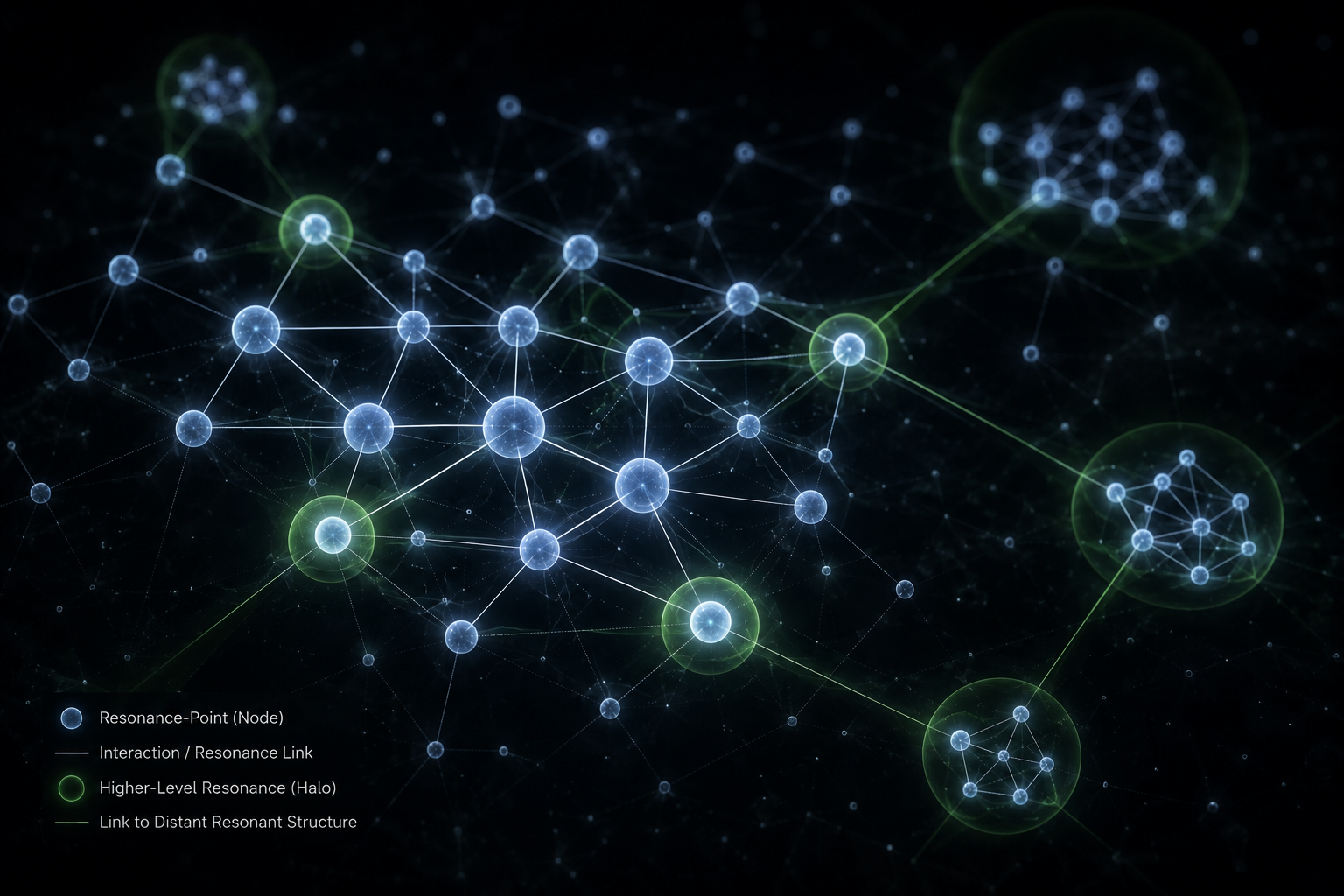
From Resonance-Space to 3D:
Revelations:
💡➜ Find out the most inspiring revelations↗
Intermediate Pre-Release Paper on RQT
💡➜ Read the official paper on “Roton Resonance Coupling Framework”↗
Or simply read on:
Scientific Assessment
The Resonance Quantum Theory (RQT) proposes that matter, interaction, and stability arise not from point particles or abstract fields, but from structured resonances embedded in space-time itself. Physical interaction emerges from relational phase coherence and phase gradients. Instead of treating observed quantum states as irreducible, the Rotonal Quantum Model (RQM) decomposes them into geometrically and axially separable resonance modes that can couple, lock, and reorganize across scales. In this view, forces are not exchanged entities but emergent consequences of phase alignment, misalignment, and resonance saturation. Complex multi-dimensional eigenstates are thus reinterpreted as composite resonance configurations with internal degrees of freedom that remain physically interpretable. This reframing offers a unified language for mass, binding, charge distribution, and interaction strength without invoking fundamentally distinct force carriers. For the reader, RQM invites a shift in perspective: from asking what particles are, to asking how stable resonant structures manage to exist at all.
If you are rather a physicist: 💡➜ Read on “From Gauge to Matter” read↗
Mathematical Framework (For Physicists)
If your primary interest lies in equations, characteristic scales, and quantitative derivations rather than conceptual motivation, consider starting with the General Resonance Calculation Framework. It provides a compact overview of the mathematical relations and experimentally anchored quantities used throughout RQT.
Basic Ideas and Entities
Light and Matter
At the most fundamental level, physical reality is structured as oscillations and their interactions building shared resonances. Embedded into three dimensions RQM models them as rotations with their axis pointed to the interaction partner. Light, energy, and matter emerge from nested rotations and their mutual resonances, forming stable, self-sustaining patterns within a dynamic resonance landscape. Spacetime is an emergent projection of this resonance landscape. What we observe as particles are localized, long-lived resonance configurations rather than isolated objects.
In short: Matter is self-stable oscillatory energy confined into resonances that create resonant loops within an oscillating resonance landscape. It’s realizations on different scales might be interpreted in Standard physics terms as a multi-layered energy-density field.
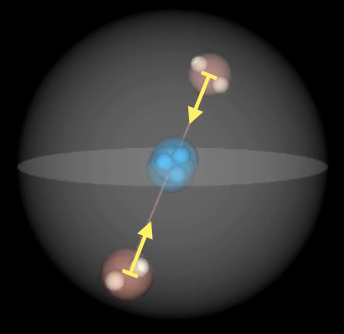
From Rotation to Resonance and vice versa
RQM tries to give a visually appealing model by using a simple axial circular rotation to define a resonance node. More complex combined oscillations might project onto much richer trajectories in 3D space.
A simple planar rotation supports stable eigenmodes: closed trajectories with periodic phase evolution, whose state is fully specified by a single cycle. When rotational subsystems are hierarchically embedded, this simplicity no longer holds. The planar eigenmode generalizes into a set of coupled, higher-dimensional wavefunction trajectories, for which closure after a single turn is not guaranteed. Stability then arises through self-resonance: only those trajectories persist whose internal rotational degrees of freedom achieve phase locking.
In this regime, resonance is not merely a dynamical feature but a structural selection principle. Hierarchically rotating sub-systems form self-resonant spatial loops whose spatial orientation encodes memory. Through the holonomy of these orientations, the system’s state becomes path-dependent rather than position-dependent. Consequently, a trajectory that is closed in space need not be closed in state, and may require multiple turns to return to an equivalent configuration.
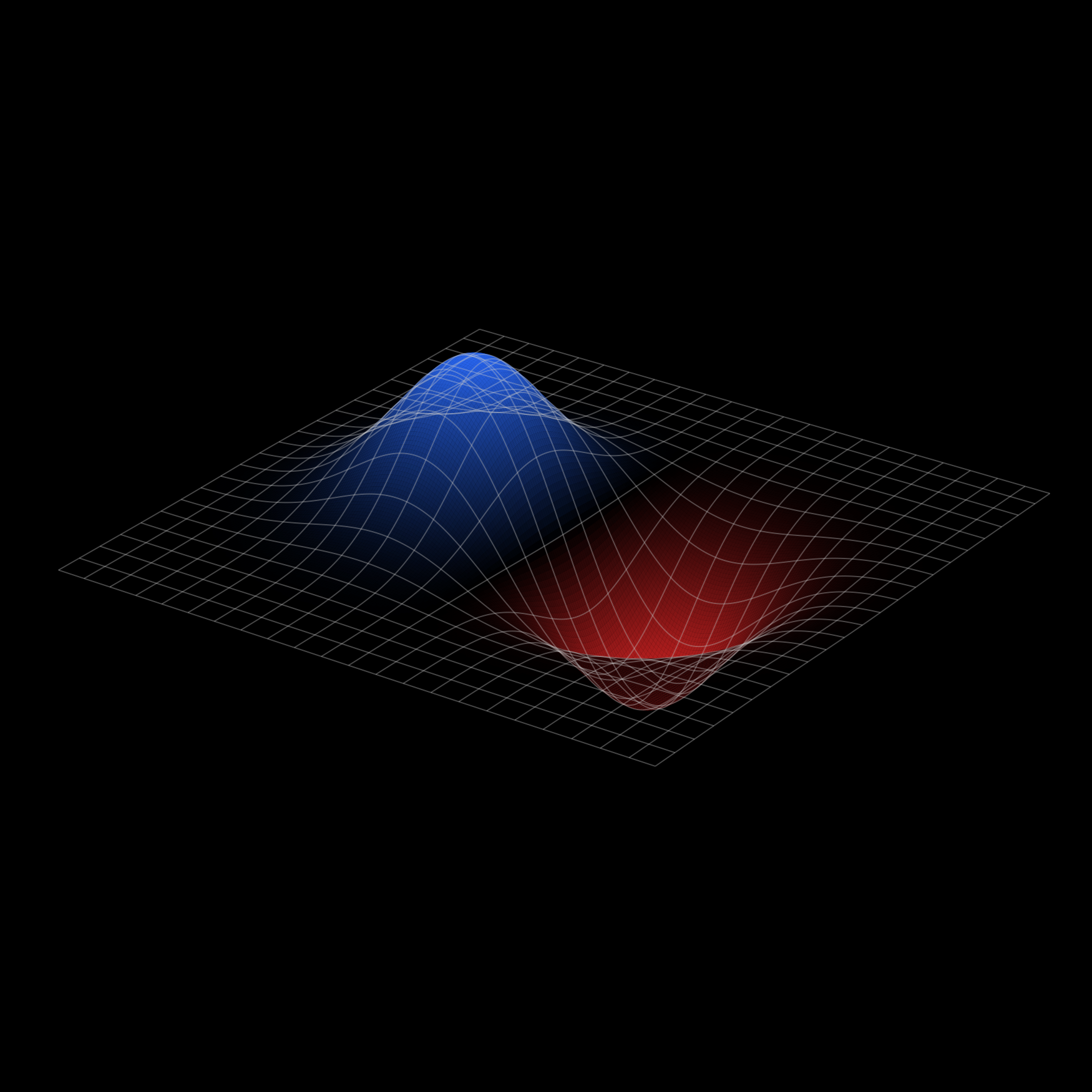

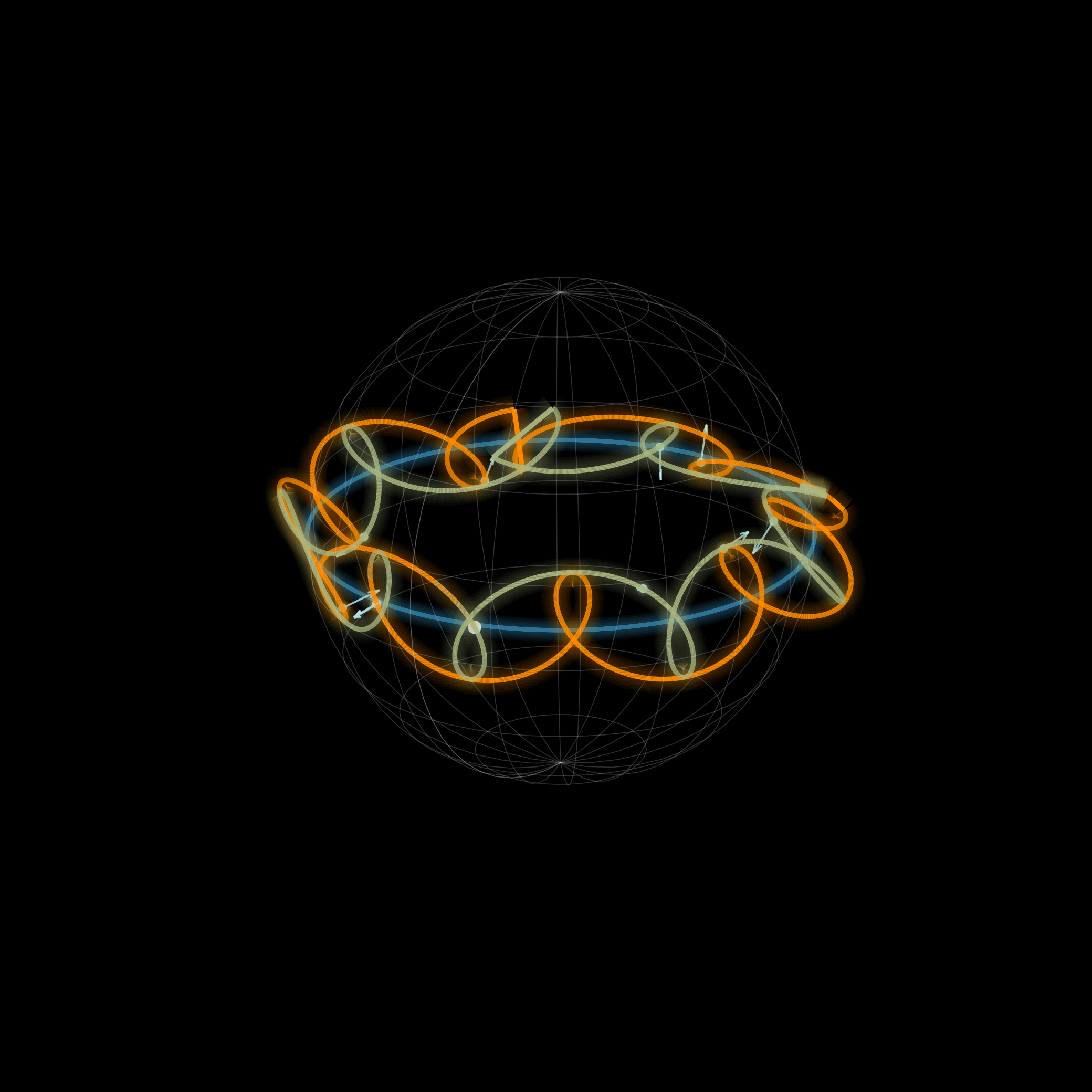
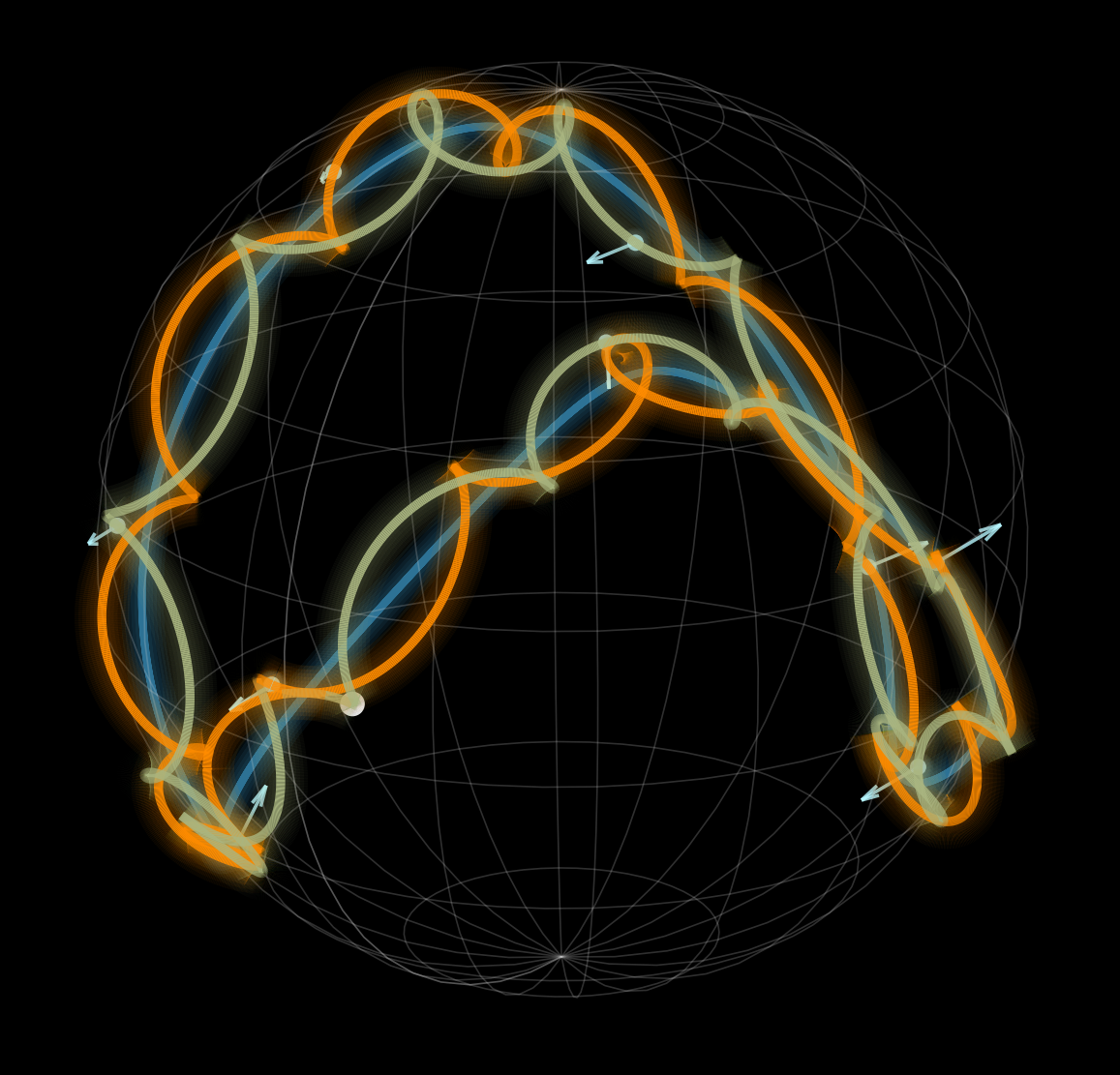
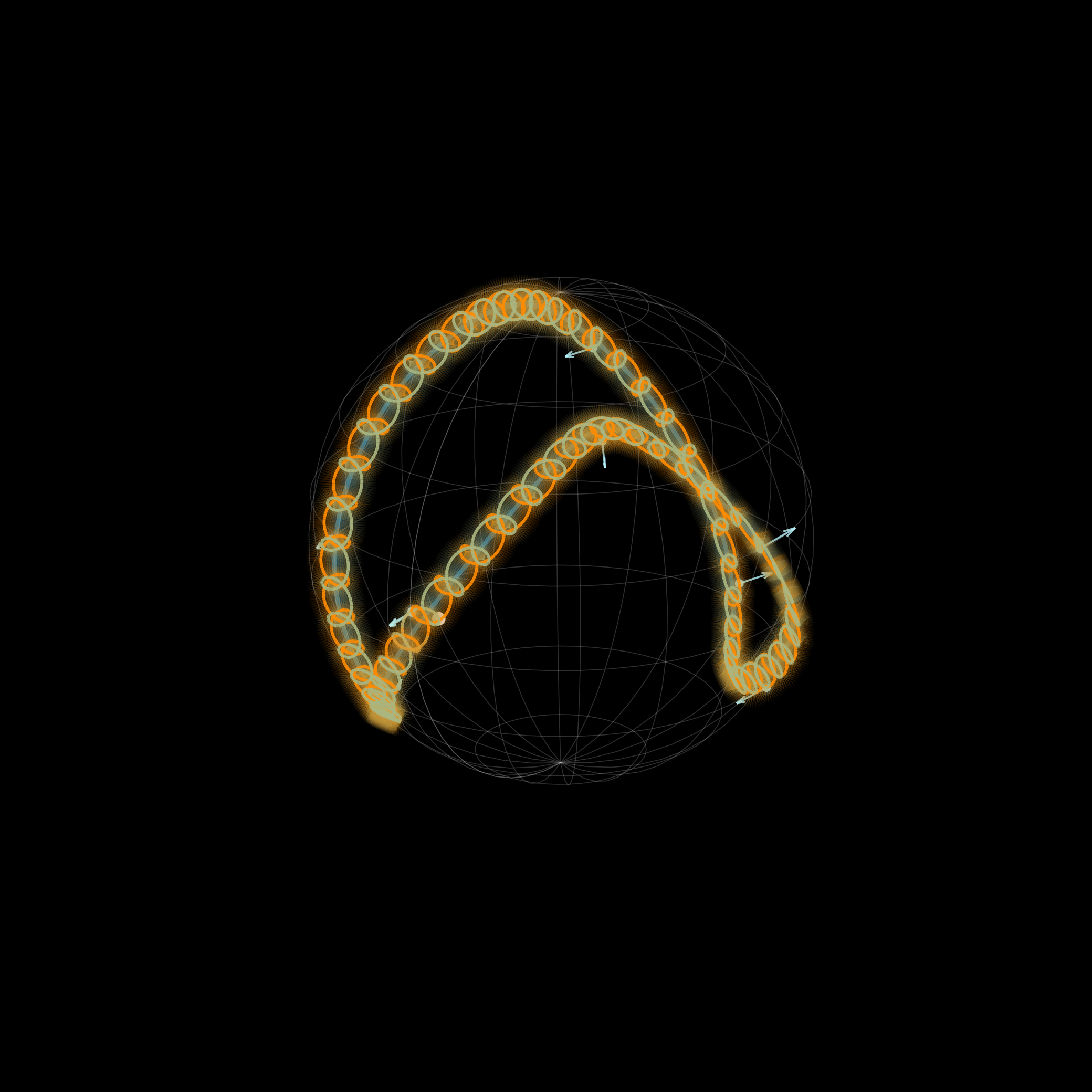
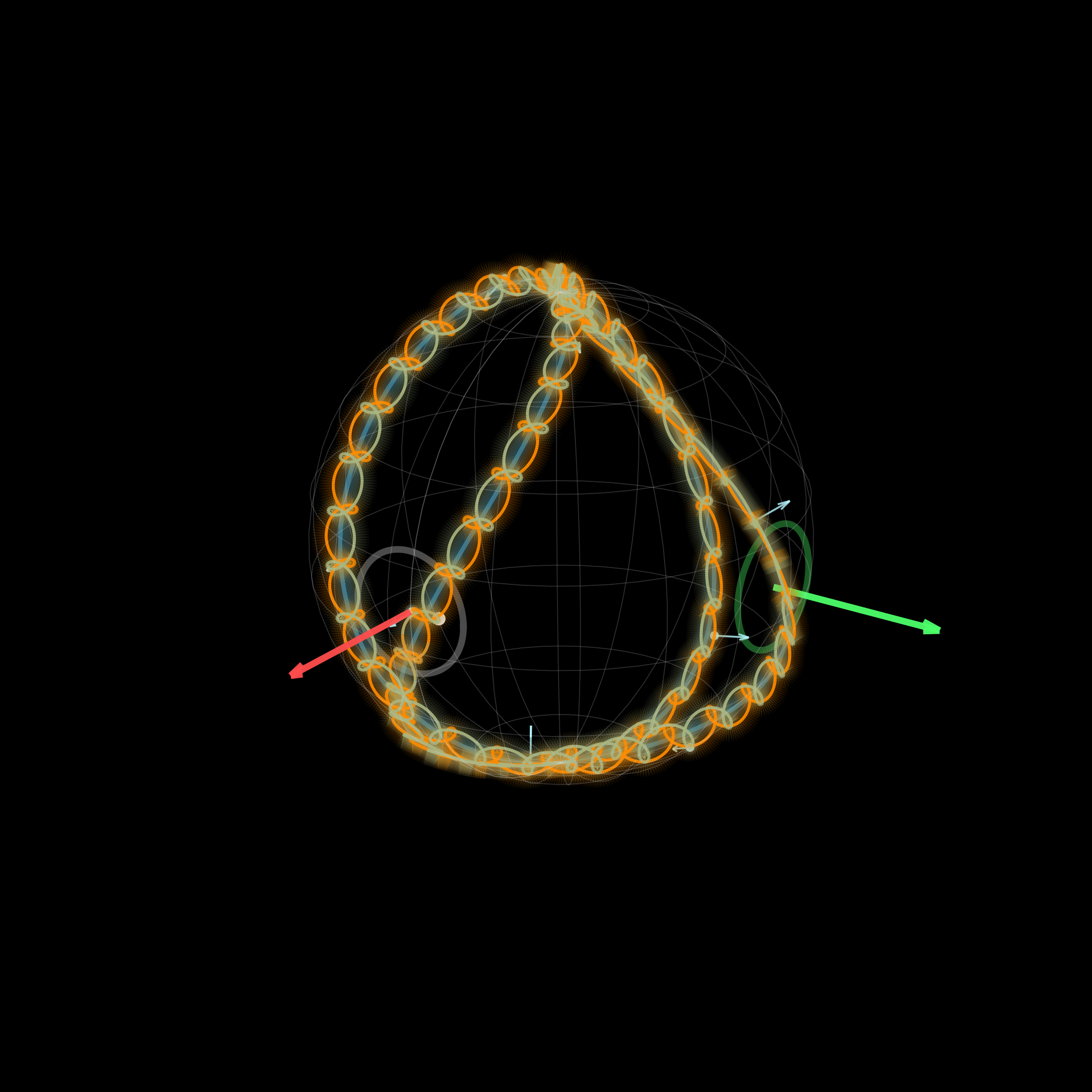
The model exposes externally accessible primary resonance channels via Roton tensors. These vectors correspond to the oriented area vectors of the configuration and define the directions of maximal resonance coupling. Internal resonance channels arising from internal rotations remain closed.
For the more visual readers, the following illustration on the photon concept may help:

You might surely love this narrative visualization of the whole RQM hierarchy:

Resonance Landscape (LEDO-Landscape) read↗
A resonance landscape defines which oscillatory states are admissible and how they may coexist. It is best associated with an interaction grid itself, which then projects their phase-difference onto admissible and compatible distances in spacetime. Distance in resonance space corresponds to phase and period numbers of an oscillation. The LEDO Landscape is neither a single field (which integrates interaction tendencies at a location), nor a medium (which would imply transport, elasticity, or propagation constraints).
The universe is described by a rotational support structure that specifies admissible oscillatory degrees of freedom. Interactions between rotational states are summarized locally by a resonance potential field (including its tensorial Inertial Gyroscopic Tensor (IGT) form), which encodes directional, phase-dependent, and gyroscopic coupling tendencies. Energy appears as occupied resonant modes within this structure, forming localized energy density oscillations (LEDOs) whose propagation and stability are shaped, but not carried, by the field. This calculatory representation in euclidean space might not be accurate for all spans and interaction regimes.
Beneath all observable phenomena lies an underlying meta-structure, termed the LEDO Landscape. It supports resonances and stable oscillating (RQT) or rotating (RQM) entities. Light, electrons, and bosons are not distinct substances, but scale-dependent resonant states of this landscape, characterized by frequency, orientation, amplitude, and spatial extent. Conventional physical fields arise as mathematical projections of LEDO-Landscape dynamics when restricted to a specific observational scale.
In the RQM model view: Resonant coupling within the LEDO Landscape induces attraction between self-resonant entities in a homologous manner, independent of their conventional classification. Rotating structures establish directed resonance potentials that define how and where coupling can occur; this coupling capacity manifests physically as inertia. The field mediating resonance-induced torque and governing rotational response is introduced as the Inertial Gyroscopic Tensor (IGT) field.
In RQT terms, attractions are only the observable effects of resonance interactions and their realization in the observable spacetime.
Physical Constituents within RQM
-
Where — Resonance Landscape
An oscillatory (rotational) support structure defining admissible resonance modes, their interactions and their degrees of freedom and hosting local resonant energy density distributions.
-
What — Localized Energy Density Oscillations
Stable oscillatory entities, background residuals and fluctuations occupying resonant modes.
-
How — Resonance Potential Field (IGT)
A mathematical description of how interactions would act, encoding directional, phase, and gyroscopic coupling tendencies.
Mathematical Modeling (RQM)
Inertial Gyroscopic Tensor (IGT) Field
A tensor field encoding directional and gyroscopic response tendencies. At each space-time point, it is defined as an integral over all contributing rotonal resonance potentials, resolved by direction, span, frequency, and phase. The IGT field does not carry energy; it structures rotational response and torque-mediated coupling.
Energ (RQM) read↗
Fields summarize how systems would interact; energy describes what is actually oscillating/rotating.
All stable rotations constitute energy. Light, electrons, and matter are different manifestations of rotating energy, organized within a hierarchical resonance structure.
Why, then, does nature appear quantized, with energy and momentum occurring only in discrete steps? Aside from freely propagating light, the world itself is not fundamentally quantized; rather, structure requires a shared base frequency that enables coherent resonance.
Transitions between resonant configurations, such as electronic orbitals, therefore occur only at specific energy differences. Systems that lack any resonant overlap with this common frequency spectrum remain effectively non-interacting, and thus invisible to our physical world.
We will later reformulate energy more precisely: force expresses resistance, inertia structures it, energy accounts for its reorganization, and acceleration reveals what remains.

Energy Conservation read↗
In RQM terms, the standard physics concept of energy conservation translates more fundamentally into the requirement of continuous resonance redistribution.
Whenever a phase change modifies a resonance structure, the resulting resonance imbalance cannot simply disappear. All affected resonance obligations must be resolved through confinement, propagation, redistribution, or coupling to surrounding structures.
From this perspective, photons, neutrino-like modes, recoil, binding energy and other observable effects are not separate phenomena. They are different manifestations of the same underlying requirement: the continuous redistribution of resonance and its phase throughout the system.
Nothing disappears. Only the resonance topology changes.
RQM Basic Resonance Structures read↗
Every stable rotation of energy constitutes an entity, which may in turn act as the basis for higher-order rotations. Such scale-relative entities are referred to as Rotons. Beginning with a fundamental soliton (a self-sustaining rotating oscillation within the LEDO-Field) the universe organizes itself hierarchically: from light to electrons, from quon-like structures to atoms, from planets to solar systems, and onward to galaxies and the large-scale Filament-Clustersread↗ of the cosmos.

From Roton to Resonon
Rotons are defined as stable, self-sustained rotations of energy, typically represented as circular or planar motion. External influences may introduce wobble or precession, yet stability is maintained as long as the trajectory remains closed and continuously differentiable. While Rotons can in principle follow arbitrary three-dimensional paths, their defining property is autonomous persistence.
In contrast, Resonons are not self-sustained. They arise when resonance channels guide energy into externally induced trajectories and remain stable only through continuous coupling to surrounding Rotons or other Resonons. Such entities persist through mutual in-weaving of resonance and play a central role in the formation of extended structures, such as valence-electron configurations.
Multi-Dimensional Rotons
Although rotonal structures may involve complex, multi-dimensional oscillations, they can often be represented as combinations of a small number of planar rotations about distinct axes. By assuming a shared center, this representation preserves coherence while greatly simplifying analysis.
In standard physics, many self-sustaining multi-dimensional oscillatory structures (e.g. Lissajous figures) are described as superpositions of sinusoidal components along orthogonal spatial dimensions, implicitly assuming a common center. The RQM follows a similar reduction in spirit, but replaces purely orthogonal sinusoidal components with a limited set of planar rotations. These rotations share a common center while being oriented along distinct axes, providing a compact representation of otherwise high-dimensional dynamics.
This representation does not imply that the underlying dynamics are planar; rather, planar rotations serve as a convenient basis. When describing detailed phase coupling and inertial response, more refined simulation models may be required. In this picture, the shared center point generalizes to a shared energy well (e.g. a Gaussian minimum), within which the individual Roton centers are confined within their characteristic radii.
In contrast to purely orthogonal mathematical decompositions, RQM explicitly allows decomposed Rotons to possess arbitrary axial orientations, distinct characteristic radii, and effective interaction cross sections. Their axes and phases become dynamically interlocked through inertial response. If induced coupling grows too strong, the composite Roton may lose coherence and disintegrate into its spatial components.
To maintain tractability, we proceed by separating such structures into individually graspable rotations. These principal resonance axes are referred to as resonance channels.
Confined Resonance Systems
Multiple coupled resonances might build up more complex resonance systems. Such structures will confine their internal resonance distribution and only act via their externally open resonance channels.
We can understand such confined inertial systems as Resonance Redistribution Nodes where different external and internal phases have to be re-aligned.

Resonance channel dynamics and energy preservation
This decomposition is grounded in energy preservation, not in the preservation of explicit trajectories. As coupling increases, the effective geometric path of the motion loses clarity and ceases to admit a simple mathematical description. What remains conserved is not the detailed trajectory, but the interaction itself: how energy is retained, exchanged, and redistributed among resonance channels as rotations along different directions. The RQM therefore tracks energy flow and phase coupling across resonance channels, rather than attempting to preserve a unique spatial path.
In short: Trajectories may dissolve under coupling; energy redistribution across resonance channels does not.
Phase Distribution Networks read↗
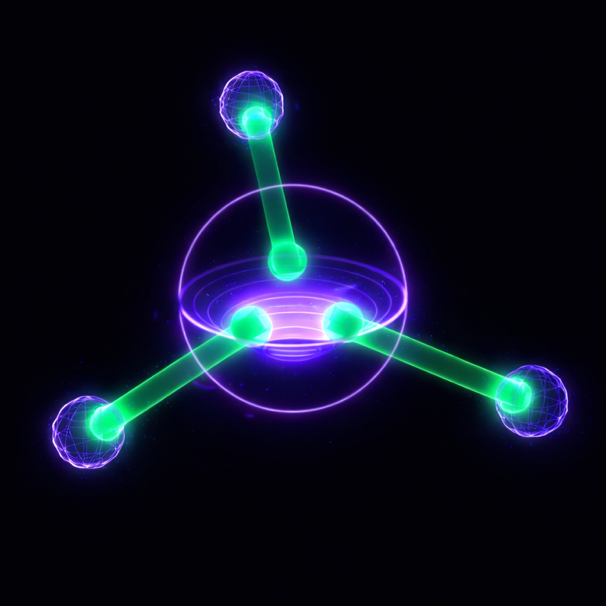
The universe can be interpreted as a vast phase-distribution network consisting of nodes and channels.
The Resonance Quanta Theory (RQT) describes physical reality as a hierarchy of interconnected resonance networks. In this view, the universe can be interpreted as a vast phase-distribution network consisting of nodes and channels. Nodes act as resonance centers where phase relationships can be stored, redistributed, or transformed. Channels connect these nodes and provide pathways through which phase mismatches can propagate and be accommodated.
Stable physical structures emerge when networks of resonances find self-consistent configurations. Electrons, photons, atoms, molecules, and larger structures are interpreted as increasingly complex resonance topologies built from simpler underlying elements. Each structure continuously seeks configurations of higher stability by redistributing phase mismatch through its available channels.
A disturbance introduced anywhere in the network creates a local phase mismatch. This mismatch propagates through connected channels, alters geometries, redistributes accommodation demand, and may ultimately lead to new stable configurations. Observable phenomena such as motion, binding, excitation, photon emission, and structural transitions are interpreted as different manifestations of this ongoing accommodation process.
The purpose of the Phase Distribution Network framework is not to replace known physical laws, but to provide a common language for describing how resonance structures interact, redistribute phase mismatch, and evolve toward stable recurrence patterns across multiple hierarchical scales.

Forces
Before discussing force, its meaning must be embedded among related concepts. In RQT force is only a residual effect. One possibility for nature to cope with phase mismatch along a resonance channel. A resonance channel changes its length to accommodate for external changes of the resonance context.
Concepts:
Inertia is the structured resistance of a hierarchical system to imposed change (directional and rotational);
Force/Torque is the relational manifestation of that resistance;
Acceleration is the structured outcome of how a hierarchical system absorbs, redirects, or resists an attempted change.
Energy measures how deeply that resistance has been reorganized within a system;
Momentum is an existing geometrical rotation and rotational inertia its resistance to changing that rotation
Rotonal Forces
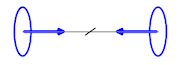
In the RQM, forces are not exchanged entities but emergent effects of phase alignment, de-tuning, and saturation between rotational resonance modes. What appears as attraction or repulsion is the systems tendency to reduce resonance mismatch and redistribute energy density and rotational phase toward dynamically stable configurations.
| Axis alignment |
Phase lock |
Position Lock |
Distance Lock |
 |
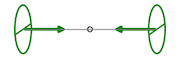 |
 |
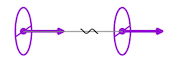 |
| Free phase |
Phase alignment (torque) |
Attractive Force |
Distance-lock force |
Attractive and Repulsive Rotonal Forces read↗ (old read↗)
Rotational energy (a Roton) generates directed torque within the resonance landscape of space–time. When multiple rotating systems are present, they couple through mutual resonances, forming resonance channels that mediate interaction. Similar rotating systems—matched in scale, frequency, orientation, and phase—tend to align, producing effective attraction. Perfect axial alignment creates an entangled pair, in which attraction depends only on resistance to acceleration or phase change, not on distance.
By contrast, uncorrelated orientations distribute resonance influence isotropically, yielding an effective $1/r^2$ spherical behavior. In this sense, standard long-range interactions (e.g. electromagnetism, gravity) arise from integrated rotational moments induced by surrounding unaligned resonance potentials, forming a tensor-like field acting on each Roton.
Repulsive Saturation Forces
All stable rotating entities generate an energy-density pressure in the LEDO-Field, corresponding to the superposition of their emitted resonance modes. At short range, this leads to effective repulsion originating from the rotonal center. The repulsive behavior arises from local saturation of resonance capacity (energy density), which inhibits further coupling and drives similar structures apart. If local phase differences can not be redistributed anymore internally, this leads to saturation and expansion into space.

No singularity
This model does not cause any singularities because there is no point-like entity anywhere in the universe. All “things” have size, a length defined by the rotation perimeter. All attractive forces within the spatial range of this rotation lengths are linear or non existent and never reach infinity. In addition, attractive forces get smaller compared to the increasing repulsive force on smaller distances. Simulations read↗ show as a prove of concept a very stable system behavior.
Stability and scales read↗
The stability and complexity of matter arise from the fact that attractive forces (rotation resonance) are not homogeneous in all spatial directions. This leads to energy-optimized structures, where the energy density reaches local maxima. At these positions, attractive and repulsive forces cancel each other out (statistically), creating (conditionally) stable configurations. Energy density optimizations happen based on natural fluctuations and waves (energy density changes) in the meta-field.
Directional Dependency
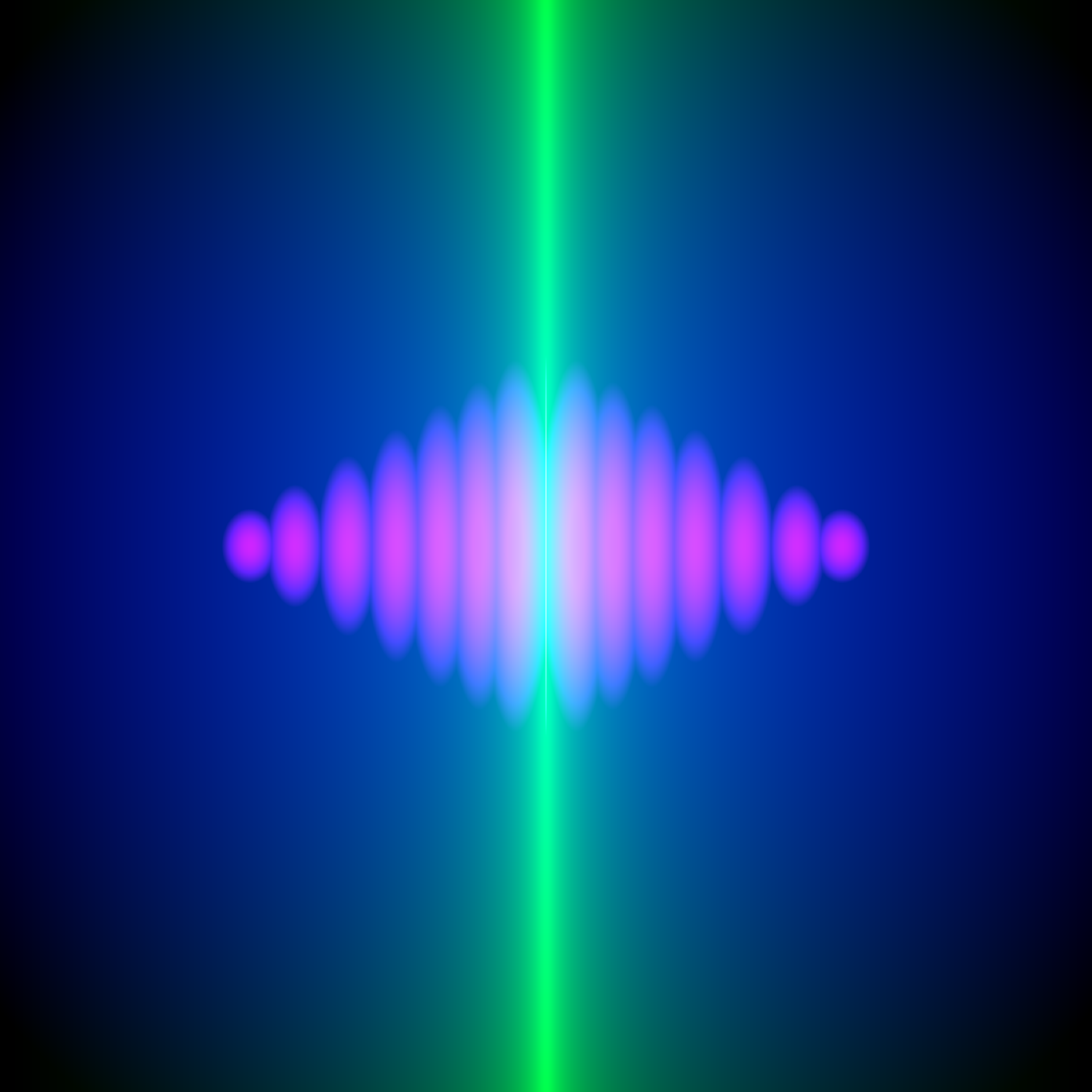
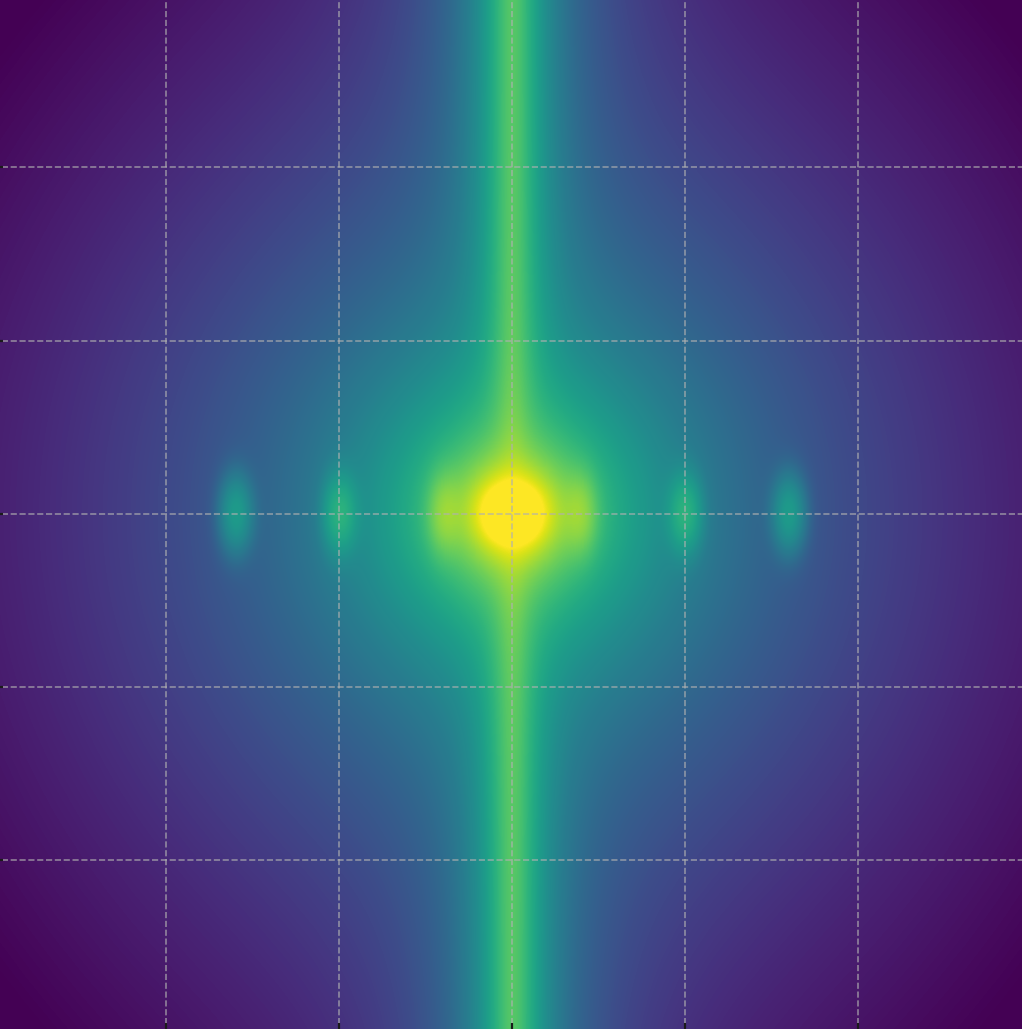
Rotational resonances exhibit distinct axial and spatial dependencies. (1) The dominant coupling is the co-axial resonance, representing a distance-independent (entangled) alignment effect that arises when rotational axes coincide. (2) For some resonances (e.g electrons), parallel-axial resonances emerge between rotations whose axes remain aligned but spatially separated, producing distance-keeping forces (phase locking) that scale approximately as $1/d$. This results in favored resonating distances and frequencies. (3) With randomly changing orientations (no axial alignments), isotropic resonance follows, contributing an attractive component in all spatial directions with a characteristic decay of $1/d^2$. (4) Finally, this hierarchy is balanced by a repulsive term associated with the gradient of the localized energy density, modeled as decaying with $1/d^3$.
These relations hold for Rotons of comparable intrinsic parameters such as size, frequency, or rotational phase.
Propagation speed read↗
Axial resonance between Rotons is established as a global agreement of compatible rotation states. This agreement is not distance-limited and shows no gradual attenuation. It resembles an entanglement-like condition of the LEDO-field, in which compatible rotational configurations are mutually available independent of separation. The resonance potential is therefore formed instantaneously as a structural condition rather than as a transmitted signal.
Yet the realization of change within stable resonant structures is constrained. Any modification of an established oscillatory configuration requires axis tilt, phase adaptation, or precessional adjustment. These operations encounter rotonal inertia arising from stored rotational energy and from the recoil associated with reorientation. Stable oscillatory compounds thus behave as coherent wholes whose resonance potentials are globally defined but whose actual motion or transformation is locally limited.
Unperturbed resonant rotations remain self-confined and homogeneous. Their couplings are continuously and instantaneously agreed without producing external acceleration. Such structures act as fully available resonance objects, maintaining internal coherence without energy exchange. Only when this homogeneous oscillation is disturbed does a local inertial response appear, expressed as a coupling to the surrounding space-time structure of the LEDO-field.
Consequently, changes in the propagation of an energy-density oscillation cannot occur instantaneously. They are constrained by the inertial response of the participating Rotons and by the angular tolerances required to preserve resonance coherence. The effective reaction speed emerges from this interplay and is further shaped by ambient background fluctuations of the LEDO-field. These fluctuations provide a probabilistic landscape in which rotating entities explore nearby configurations of improved energy-density balance.
While the LEDO-field itself oscillates as a global integral without spatial delay, coherent objects migrate only gradually through successive local reorientations. They settle into rotation axes and trajectories that preserve coherence while minimizing energetic tension with the surrounding field. In this manner, autonomous oscillatory structures follow natural energetic geodesics, provided their adjustments remain within the tolerance range set by the background LEDO fluctuations.
Static field = Resonance Potential field
In RQM, static electrical and gravitational fields represent the same underlying concept: a resonance potential field. Both describe the global availability of compatible resonance states between Rotons. Wherever coherent resonance compatibility exists, the corresponding potential is present immediately and without distance-dependent attenuation.
Entangled or resonance-coupled systems share this resonance agreement as a structural condition of the LEDO-field. Event-resonance potentials are therefore globally distributed. A static field does not arise from a propagating signal but from the existence of a realizable coupling. Electrical and gravitational fields are thus instantaneously available as resonance potentials. Consequently, a target is attracted toward a source at its actual current location, not at the historical position from which a photon may once have been emitted.
Predictions:
- Static electrical and gravitational forces reflect globally available resonance potentials and therefore always refer to the actual configuration of the source.
- Changes in these potentials generate propagating adjustments. These appear as photons (electromagnetic waves) and are limited by the characteristic propagation speed of such disturbances.
- Any change requiring photon exchange or field reconfiguration is subject to inertial coupling with the surrounding environment and cannot occur instantaneously.
- Internal adjustments of multi-rotational coherent objects can remain self-contained and periodic when confined within closed resonance cycles. Such internal reconfigurations remain inertial but may occur without radiative energy exchange if coherence is preserved.
This framework suggests that multi-rotational systems naturally converge toward fast periodic repetition of sub-rotations. By locking into closed resonance cycles, the object maintains coherence without requiring continuous photon-mediated adjustment. Energy dispersion through radiation becomes unnecessary as long as internal resonance compatibility is maintained.
The immediate availability of static attraction does not contradict relativity. Relativity constrains the propagation of changes in fields, not the existence of globally consistent field configurations. In RQM, static resonance potentials are structural properties of the LEDO-field, whereas photons represent carriers of discrete adjustments of these structures. The speed of light therefore characterizes the propagation of causal disturbances within the field, not the existence of resonance compatibility itself.
A constant, distance-independent availability of resonance-coupled attraction emerges as a necessity for coherent trajectories of interacting systems. Without such globally available potentials, stable motion under static fields would require continuous photon exchange and would lead to persistent radiative loss. The persistence of coherent, non-radiating trajectories thus reflects the presence of stable resonance potentials that do not require ongoing signal-mediated maintenance.
Global Resonance Agreement
The Resonance Coupling Field (IGT) establishes resonance channels through a global, a-temporal resonance agreement rather than through time-propagating interactions. It determines whether a resonance can exist as a consistent, fully realizable structure, independent of temporal ordering. This requires causality on undisturbed levels to be bi-temporal. Resonance existence is conditioned on mutual consistency between forward- and backward-temporal boundary conditions, similar to the ends of a violin string. The IGT therefore evaluates resonance compatibility across time as a whole, not along a directed timeline.
Bi-temporal causality is a direct consequence of global resonance agreement. Apparent retro-causal effects occur when future-compatible configurations participate in resonance consistency, not through backward signaling. If a system fails to realize the required future interaction, the resonance agreement never existed, and no information was exchanged across time.
Continuous perturbations that prevent backward-compatible boundary conditions suppress the formation of stable entangled resonances. Consequently, persistent global resonances are expected only in regimes of high temporal coherence, notably at quantum scales and possibly at cosmological scales. Extreme boundary conditions, such as event horizons, may relax these constraints and re-enable large-scale global resonance structures.
Inertia and Decoupling
Inertia decoupling↗
General Inertia↗
As a general recapitulate: Inertia emerges where resonance patterns form persistent circulation.
In the rotonal view, inertia can be interpreted as the time required for a system to realign its internal phases into a coherent configuration. During this interval, the system cannot fully sustain its external resonance channels and temporarily ‘decouples’ from its surroundings.
A system is considered to be in a coherent (or confined) state when its internal phase relations allow it to respond as a unified compound. In such a state, it maintains a stable center of energy density interacting as a resonance channel. The center comes together with a continuous symmetric internal flow of energy density, enabling consistent coupling to external structures.
Coherence is therefore not an isolated property but a symmetric dynamical relation: systems with comparable coupling capacity mutually establish and maintain resonance channels only to the extent that each can preserve its internal phase alignment.
Photon emission (RQT)
Photon Emission, Atomc Excitations, and Resosnace Closure in RQT↗
Resonance networks can continuously adapt, but complete closure requires exact phase synchronization, and when closure occurs faster than the environment can accommodate it, a photon is required to preserve the displaced resonance relation.
In RQT a photon is basically a detached e-span resonance-preserving structure that temporarily maintains a resonance relation after a channel closure has occurred faster than the surrounding environment can accommodate the resulting change.
Higher-level resonance closures that outrun accommodation generally lead to structural reconfiguration or fragmentation. Photons arise when the remaining unresolved closure relation reaches the e-span level, where a stable detached resonance carrier becomes possible.
Field
In RQT, the term field (e.g. an electric field) is deliberately avoided as a fundamental concept.
A field is the spatial representation of how an underlying resonance organization can realize interactions. The observed field effect arises when another resonance identity participates in that organization; the field itself is not taken as a fundamental constituent of RQT. A field therefore describes how something would behave within the spatial projection, but it is not itself the source of that behavior. It is a mathematical representation of the resulting observable relations.
In RQM, the standard terms field and radiation can refer to several distinct physical situations that share a common basis in resonance dynamics but differ in their realization:
- The presence of electrons establishes persistent externally realizable resonance relations, appearing in the projection as a static electric field.
- Higher-order Rotonal systems can establish analogous persistent relations, appearing as a static gravitational field.
- When interacting Rotonal systems cannot maintain compatible coherent dynamics, resonance reorganization may require a propagating adjustment. One possible realization is photon emission, carrying the corresponding projected energy and momentum.
- Photon emission appears in the spatial projection as a propagating electromagnetic disturbance traveling at speed (c).
- Photons themselves establish propagating resonance relations. Unlike static configurations, these generally do not establish persistent local coupling conditions, but act as transient carriers of resonance adjustment.
Photon Radiation
Radiation may emerge when a persistent resonance structure can no longer maintain its present coherent organization and must transition into another compatible state. Changes in phase relations, realized motion, or internal resonance organization may leave part of the previous relation unable to remain enclosed within the reorganized structure. This difference can be realized as a propagating resonance identity, such as a photon.
Photon emission therefore allows the emitting structure to transition between coherent configurations while preserving the corresponding projected conservation of energy and momentum.
The term radiation describes the propagation of such resonance organization rather than the static presence of a field. Persistent field-like behavior corresponds to continuously realizable resonance relations, whereas radiation corresponds to a resonance identity that propagates independently through successive realizations.
In the RQM projection, photons propagate at speed (c). RQT interprets this not primarily as the motion of a small object through a pre-existing spatial medium, but as the characteristic spatial realization of a self-propagating resonance identity. Its internal resonance organization does not require the repeated structural reconfiguration associated with inertial matter.
Photons generally do not establish persistent mutual coupling because their propagating resonance conditions are already self-consistent. Interaction becomes possible where compatible resonance relations with other structures can be realized, allowing absorption, redirection, or further reorganization.
A change in a photon’s projected momentum or trajectory therefore requires a change in its resonance relations with its environment. In RQT, such changes are attributed to resonance interaction rather than to a photon responding to an independently existing force or field.
Photon and Light (RQM)
A photon represents one of the elementary realizations of a Roton, characterized by a single axis rotation of two Sonons. Its propagation at the speed of light follows directly from this structure: as long as its rotation axis remains unchanged, no inertial resistance to translation is imposed. In this sense, a photon propagates at maximal speed not because it is driven, but because nothing opposes its motion. At the same time, this also results in a reduced resonance coupling, reinforcing this unrestricted propagation.
Visual aid:
The apparent speed limit of light can be discussed from two complementary perspectives, both subordinate to this invariant.
First, even a nominally planar LEDO base-soliton possesses a minimal orthogonal extent. If not inherent, background fluctuations inevitably introduce small transverse components. As a result, the photon’s self-induced acceleration via its own energy-density gradient is weakly constrained by its resonance characteristics and by ambient fluctuations. This does not reduce its speed, but slightly broadens the space of admissible motion.
Second, the model predicts residual coupling to the surrounding universe. Even an ideal planar Roton experiences axial resonance potentials from other photons that are accidentally aligned along similar oscillation axes. Although a photon’s phase is internally unrestricted and adapts instantaneously, transient virtual axis alignments still occur. These fluctuations largely cancel statistically, yet their integration requires finite response time governed by the Inertial Gyroscopic Tensor (IGT) field, inducing a minute precessional component. Preserving the relative rotation axis may therefore lead to subtle changes in propagation direction.
Pure RQM: In this sense, a pure photon is a one-dimensional oscillation that would propagate without time dilation, but is weakly forced into an effectively two-dimensional motion, acquiring a vanishingly small rotational inertia. Consequently, the speed of light may depend weakly on the integrated background resonance fluctuations of a given region of the universe. Passing near heavy masses—composed of or containing many photon-like components—may therefore induce slight changes in a photon’s rotation axis and trajectory, without altering its local propagation speed.
Pure RQT: RQT does not require a photon to continuously travel through every point along a spatial path. Emission establishes a propagating resonance relation with its own time evolution. The photon becomes spatially realized again where that accumulated evolution, meets a compatible resonance structure in spacetime. Absorption is then the re-coupling of that propagating relation into matter.
Postulate: A photon is a basic Roton with a single one-dimensional oscillation, yet remains susceptible to minimal precession.
Takeaway: A photon may follow non-linear trajectories without loss of speed, provided its rotation axis remains unchanged.
Base Resonance (Sonon)
A Sonon is introduced as the smallest fundamental, self-sustained oscillatory entity. At its base, a Sonon requires only the presence of space-time itself to support its resonance.

This resonance possesses an intrinsic directional (vectorial) character. It can be envisioned as a rotating pair of positive and negative crests within a field, continuously feeding into one another while circulating around a common center. Its amplitude and spatial extent are not fixed, but are constrained by background fluctuations and LEDO dispersion.
Considering the properties of a base Sonon within the LEDO landscape, the question of its spatial extent naturally arises. However, since the LEDO landscape interacts with observable structures only through stable excitations (higher-level Rotons), the intrinsic size of a base Sonon is not directly constrained by observation. From this perspective, a Sonon may appear effectively point-like when viewed through its center, or it must remain smaller than the interaction range of the higher-level structures it gives rise to.
In addition, the stability of an isolated base sonon might be questionable. A photon or an electron might provide a stable “home” for a sonon. Does an isolated sonon eventually disolve, or is it simply (nearly) not interacting with us?
A lower bound on its characteristic scale can nevertheless be approached indirectly. If Sonons participate (e.g. in pairs) in the formation of the smallest photon-like excitations, then their rotational structure — and in particular their characteristic radius — must remain consistent with the shortest physically meaningful wavelengths.
This consideration suggests a natural limiting scale, one potentially already identified in fundamental physics: the Planck length.
Using the characteristic parameters: the speed of light $c$, the gravitational (inertia) constant $G$, and the reduced Planck constant $\hbar$, one obtains the Planck length
$L \sim \sqrt{\frac{\hbar G}{c^3}} \approx 1.6 \times 10^{-35}\ \text{m}.$
The Planck constant $\hbar$ sets the fundamental scale of quantum action, relating energy and frequency, and governs the discreteness of physical processes. Its appearance here reflects the interplay between quantum mechanics ($\hbar$), inertia ($G$), and relativistic causality ($c$), defining a natural limit where these domains converge.
Energy ↔ frequency: Every oscillation carries energy $E = \hbar \omega$
Momentum ↔ wavelength Links spatial structure to motion $p = \hbar k$
Angular momentum quantization Rotation comes in discrete units $L = n\hbar$
The Planck length marks the scale where oscillation (quantum), curvature (gravity), and propagation (relativity) become inseparable. Thereby $\hbar$ becomes the minimal “action per cycle” required for a self-sustained oscillation to exist - potentially above the background noise.
At this stage, it is useful to tentatively map familiar excitations onto the Sonon hierarchy. A photon may be interpreted as a one-tier di-Sonon, while an electron corresponds to a three-tier Sonon. In this picture, neither exhibits a fixed spatial extent; observable size emerges only through interaction.
Photon–electron interaction can then be viewed as the transient formation of a Sonon pair, with an accompanying IGT torque that carries the counter-momentum. As this inertial change propagates through the electron’s structure, further relaxation proceeds via the creation of a Sonon/anti-Sonon pair, which rapidly forms a resonance-coupled Roton.
The spatial extent of this intermediate structure is set by the absorbed energy. Starting effectively from zero separation, the two entangled Sonons relax toward a distance that matches the imposed momentum, while the emitted photon carries away the residual difference. At this level, the process can be treated in purely kinetic terms.
Energy Dissipation Across Resonance Levels
Does every change in rotonal properties necessarily lead to the emission of a photon? Not necessarily. A Roton may redistribute its energy through higher-level resonance channels rather than emitting radiation directly. In atomic systems, for example, energy changes are often transferred into collective modes, such as thermal vibrations, via inter-atomic coupling. In this way, energy is retained within the system as increased kinetic motion rather than being radiated away. Maintaining stable inter-atomic distances allows the system to accommodate additional energy without altering its structural configuration. The system adjusts internally, redistributing energy across available resonance channels.
This raises a subtle point: does an electron within an atom experience attraction from large external masses such as the Earth? In principle, yes — but in RQM terms only indirectly, via its parent rotonal span. The interaction is not absent; rather, confinement largely decouples the electron from direct, directional external influence. Its motion is governed by intra-atomic resonances that define a stable configuration. External forces act primarily on the system as a whole and do not significantly perturb the internal orbital structure.
In this sense, a fully established resonance structure remains shielded from external perturbations across scales, with external interaction occurring only through resonance channels that remain open.
Photon Propagation and Interaction read↗
In the Rotonal Quantum Model (RQM), a photon is a minimal one-axis oscillatory pair of Sonons whose identity is inseparable from its propagation. It does not interact by slowing down, but by reorienting its propagation axis through resonance coupling. Time dilation does not apply, as no independent internal clock exists beyond its phase evolution. Phenomena such as gravitational lensing can then be interpreted as a gradual precession of this axis within an anisotropic resonance landscape. The speed limit $c$ may reflect an underlying constraint imposed by LEDO background fluctuations and Sonon properties, which minimally couple planar propagation into three-dimensional space.
[read more]↗
[Photon emission and atom excitation]↗
Resonance Space Projection
RQT distinguishes between intrinsic resonance relations and their spatial realization. The distance between two identities in Resonance Space need not correspond directly to their projected separation in 3D. A structure may therefore be compressed, extended, or even only partially representable within a particular spatial projection. Classical space may simply represent a regime in which these relations happen to map approximately one-to-one.
This suggests opposite-looking effects at different levels of organization. Subatomic resonance structures may contain more relational organization than can be uniquely represented in 3D, while galactic structures may be spatially more extended than their intrinsic resonance separation would suggest. A provisional projection factor such as (\Lambda=D_P/D_R) can describe this mismatch, although RQT would ultimately need the projection relation to emerge from the resonance organization itself.
For higher-order systems such as galaxies, projection is not merely passive. Spatially realized motion determines recurrence, periods, phases, and centers, which in turn modify the next resonance relations. A persistent galaxy may therefore be understood as a resonance of resonances whose feedback becomes self-consistent: resonance → projection → recurrence → resonance. Its apparent boundary could mark the region beyond which individual stellar recurrences can no longer maintain collective closure.
This opens the possibility that some phenomena attributed to missing mass, characteristic physical scales, or even large-scale geometry reflect properties of resonance-to-space realization rather than additional fundamental entities. Importantly, this remains a hypothesis: introducing an arbitrary projection factor would explain little. The interesting test is whether a common resonance dynamics can itself determine which spatial realizations are stable and thereby produce the observed structures and discrepancies.
Standard physics and quantum theory read↗
How does the Roton model translate into the language of standard physics? This note offers a mapping between the two, aiming to stay as close as possible to familiar concepts while minimizing model-specific terminology.
Elementary Particles read↗
When multiple Rotons approach and overcome their mutual energy density constraints, they can form stable compound structures. In this way, simple excitations give rise to higher-order, spatially extended configurations.
Within this framework, an electron is understood as a compound of three co-centered Sonon pairs (Base-Rotons), forming a three-tier resonance structure. These coupled oscillatory modes span three spatial directions and establish a stable, self-consistent configuration around a common center. Its spatial extent can be described through three interconnected rotational axes.
Postulate: An electron is an elementary particle defined by a closed, three-tier resonance of coupled Sonon pairs, enabling stable interactions and entanglement across three spatial dimensions.
A neutrino may be viewed as a minimal compound of two coaxial Rotons — a near-planar excitation that begins to exhibit precessional behavior. With this slight extension beyond a single axis, it remains extremely close to propagation at the speed $c$. Neutrinos typically emerge in nuclear decay processes, where deeper resonance channels decouple from atomic structure. While elements of their original correlation persist, the release of momentum can separate them into distinct, weakly coupled precessional modes.
Model note: Earlier versions of this model interpreted the electron as a compound of photons arranged in three rotational modes. This interpretation has been replaced by the Sonon-based description to better capture the underlying resonance structure and the effectively point-like behavior observed for both.
Visual aid:

Compound Matter
Driven by energy density gradients and background fluctuations in the LEDO field, the system continuously tends toward more stable energy distributions. Rotational electron compounds form and organize into configurations that locally counteract dispersive tendencies. Electrons pair and couple (as observed in atomic structures), creating stable rotational arrangements that reinforce coherence.
As these structures grow in complexity, layered rotational electron compounds give rise to increasingly stable configurations, maintaining distinct spatial separation while preserving internal resonance balance.
Spoiler: In the RQM framework, electrons form nuclei by occupying fixed and rotational modes with defined spatial structure. These configurations act to localize and stabilize electron arrangements, attracting and organizing additional electrons into orbitals while reducing exposure to external resonance channels (e.g. quon-level interactions). In effect, this leads to a reduction in residual coupling to gravitational-like background influences.
The full RQM hierarchy:

Object Tiers
There appear to be distinct levels of organization in Rotonal objects, which we introduce here as Tiers. A Tier characterizes how many spatial dimensions are engaged by the object’s resonance coupling.
- Tier 1 — Photon
- A photon represents the first Tier of a Rotonal object, with resonance is locked along a single axis. It has no internal sub-structure extending into additional dimensions and exhibits no native precession. As a result, it propagates linearly at speed $c$, with no internal inertia arising from rotational substructures and only minimal coupling during free propagation.
While interacting with matter or other photons, a reorientation of its rotation axis may occur without introducing measurable delay.
Postulate: A photon may follow a curved trajectory provided this does not require a change of its rotation axis — i.e., the axis remains orthogonal to the plane of curvature.
- Tier 2 — Neutrino
- A neutrino can be described as a Tier-2 Rotonal object, characterized by two coupled rotational axes (or a primary axis with a slight tilt). This additional degree of freedom introduces minimal internal structure, allowing propagation at velocities very close to $c$ while maintaining weak interaction with surrounding structures.
Its configuration permits limited precessional adjustment, enabling alignment with external resonance conditions while keeping inertial effects small. Due to the scarcity of compatible resonance channels, neutrinos interact only weakly with other Rotonal objects.
- Tier 3 — Electron
- An electron is a Tier-3 Rotonal structure composed of three coupled Tier-1 units, forming three orthogonal rotational axes. This fully developed configuration establishes a stable, spatially extended resonance structure.
The electron is therefore localized and resists changes in its rotational axes, giving rise to effective inertia. While uniform motion is sustained, acceleration requires reconfiguration of all coupled axes and is thus constrained by internal rotational dynamics. In this sense, rotational coupling defines an upper bound on its response to external forces.
- Tier 3 to N — Quon
- Beyond Tier-3, electrons with multiple accessible resonance channels can organize into clusters and extended grids. At this stage, we introduce the term Quon to denote higher-tier Rotonal structures arising from such multi-channel coupling. Simple nuclear configurations (protons and neutrons) can be modeled as rotationally stabilized variations of locally interconnected electron-based resonances. As structural complexity increases, additional resonance channels (Tier > 3) become necessary to sustain more intricate and symmetric configurations. A Quon refers to a compound structure in which parts of the system exhibit collective rotation or oscillation as a coherent unit. For instance, an isolated neutron may correspond to a lower-tier Quon composed of Tier-3 Rotonal elements, whereas more symmetric structures—such as alpha-like configurations — may require higher-tier Quons (e.g. Tier-6) to support geometries resembling dodecahedral or icosahedral arrangements.

Time and Rotonal Inertia
Time: In the RQM view, time is based on local oscillation periods. Time typically manifests as resistance of a system to instantaneous reorientation of its rotonal alignment. Any change in orientation, phase, or resonance configuration requires a finite adjustment process, and this resistance defines the local “flow” of time.
Photon limit: A photon represents the limiting case: with no internal multi-axis substructure, it offers no resistance to phase reorientation. Phase evolution and propagation are identical, and no independent internal state accumulates. In this sense, photons experience no proper time. Only reorientation of the rotation axis might be affected by some fluctuation effects.
Rotonal inertia: As systems gain internal structure—through additional tiers and coupled resonance channels—they develop rotonal inertia. This inertia reflects the need to coherently reconfigure multiple coupled axes and phases. The more tightly bound and energetically dense the configuration, the greater the resistance to reorientation.
Time dilation: Increased rotonal inertia manifests as slower local time evolution. Highly structured or dense systems require more coordinated internal adjustment, leading to effective time dilation. In this view, large masses and extreme configurations (e.g. compact objects) correspond to regions of high rotonal inertia.
Interpretation: Time is therefore not a universal background parameter, but an emergent measure of how readily a system can adjust its internal resonance structure. Fast systems reorient easily and “experience” little time; complex, strongly coupled systems evolve more slowly.
Dark Matter read↗
In the RQT perspective, phenomena commonly attributed to dark matter need not arise from an additional form of unseen matter. They may instead reflect the large-scale dynamics of collective resonance organization and its spatial realization. Observed discrepancies, most prominently the unexpectedly high orbital velocities in the outer regions of galaxies, are conventionally modeled through additional gravitating mass. RQT explores a different possibility: a galaxy exists as a persistent higher-order resonance structure whose many independently recurrent constituents establish mutually compatible resonance relations.
In this picture, stellar trajectories are not determined solely by the baryonic mass distribution and their instantaneous projected 3D separations. Orbital recurrence, period, phase, and effective center contribute to the evolving resonance relations of the galactic structure. A persistent galaxy corresponds to a regime in which this resonance → spatial realization → recurrence → resonance feedback becomes collectively self-consistent.
A further possibility arises from the RQT distinction between intrinsic resonance separation and projected spatial separation. Two stars may be sharply localized and widely separated in 3D while their effective separation within the underlying resonance organization is smaller. The projected galaxy may therefore be spatially more extended than its intrinsic resonance relations would suggest. Dynamics inferred from projected distance alone could then appear to require additional gravitational mass.
This interpretation does not dispute the observations associated with dark matter. It proposes that at least part of the inferred “missing mass” could instead represent missing resonance dynamics and projection structure: collective relations that are not contained in a description based only on baryonic mass and projected geometry.
Working hypothesis: Some phenomena attributed to dark matter may arise from collective resonance organization in galaxies and, potentially, larger structures such as cosmic filaments.
Prediction: The inferred discrepancy should depend not only on baryonic mass distribution, but also on recurrence structure, dynamical history, and the degree to which a system has established stable collective resonance closure. Disturbed, merging, or newly reorganizing systems may therefore exhibit different apparent mass discrepancies from dynamically settled systems with comparable baryonic content.
Further hypothesis: A galaxy may possess a natural resonance boundary. Beyond this region, stellar recurrences can no longer maintain compatible closure with the collective galactic resonance and objects cease to remain part of the persistent resonance structure.
Possible tests: Galactic rotation curves, dynamically disturbed and merging systems, dark-matter-deficient galaxies, satellite dynamics, and the relation between galactic structure and inferred mass discrepancy provide potential observational tests. Any successful RQT account would ultimately need to derive these effects from a common resonance-to-projection dynamics rather than introducing an independently fitted “dark matter replacement” for each system.

Atom Nucleus - where matter arises from sonons
RQM proposes photons being a coupled pair of moving sonons, whereas electrons are modeled as three sonons at the same place. An electron offers 3 resonance channels which allow multiple electron-like nodes to place themselves in distance-locking distance. Multiple of these start to create triangular and tetrahedral structures. These are the basic blocks of atomar nuclei.
Atom Physics - orbitals
We show an alternative Olavian Atom Model. It’s intuitive character is based on attractions of resonating Rotons. Depending on the environment, atoms take different structures and varying energy optima. The Olavian Atom orbitals are closed trajectories taking up the combined resonances of multiple base rotations. The p-orbitals or resonant couplings to s-orbitals of different sizes, e.g. p2 couples to the s1 and s2 shells.
Atom Orbital Model read↗
We first focus on the electron orbital representation of atoms. Atoms are an optimization of rotational energies to iteratively reach more energetically optimal rotations in respect to the Roton Model. The most attractive constellations are co-axially entangled (electron-proton-proton-electron) Roton coupling combinations. Furthermore electrons find their places in resonant distances from the center. Further optimizations allow electrons to lock into resonances with multiple other electrons with different rotation radii (a Resonon). An electrons planar Rotonal rotation can start to precess (tilt) to couple with electrons of different shells.
Finding: The standard physics term “excitation” (e.g. of a quark or electron) often translates well to temporal “precession” within the sub-roton states.
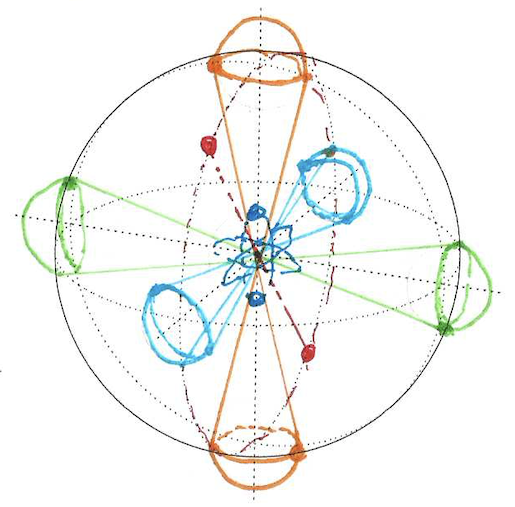
Why do bonds between atoms lead to stable molecules? Let’s understand the most attractive binding type and reveal that it is based on electron entanglement and electron trajectory resonances. Even electrons of different atoms can create “Entangled” pairs, while still keeping their entanglement to “their” own protons alive. This again leads to the most attractive bond between two electrons and two protons of different atoms. The radius of valence shells in a molecule are driven by this bonding - and are roughly equal between different elementary atoms.
The Electron read↗
The electron, one of the most fundamental particles in nature, remains among the least understood. We try to build an electron based on photons traveling on self-resonant loops. The master class, want to try yourself before jumping into the authors visionary proposal?
Insight: Electrons build entangled chains keeping their distance and speed in a common direction. For instance when passing along an atom lattice. The protons of the atoms are not expected to disturb them, as the free electrons do not have individual rotonal entanglements to the atom cores.
We will show how protons can be structured with Rotons such that we can describe the observed Electron-Proton attraction.
Insights: Leptons (Protons) are ‘cages’ that keep charge (e+/e-) stable in space and orientation. Such a cage shell is called Proton when it contains an electron locked in space and phase.
A proton may be interpreted less as an elementary seed of matter and more as the long-lived remnant of collapsed higher-order resonance structures within atomic cores.
Nuclei (Proton, Neutrons, Alpha) read↗
The Nucleus of an atom consists of Protons and Neutrons, as they say. It has this task: Provide maximal attraction for the resonant orbital electron trajectories. So the proton or more precisely the co-electron in the nucleus needs special geometrical freedom to provide the rotating electron with the constant possibility to share their axis. The nucleus shows nearly symmetric compound-objects to hold lepton(s). A structure that confines the protons “charge” (co-axially anti-parallel to electron). This allows the entangled electrons location to rotate freely and remain entangled. completely independent of the other protons and neutrons on the nucleon. All nuclei contain one or two such Leptons.
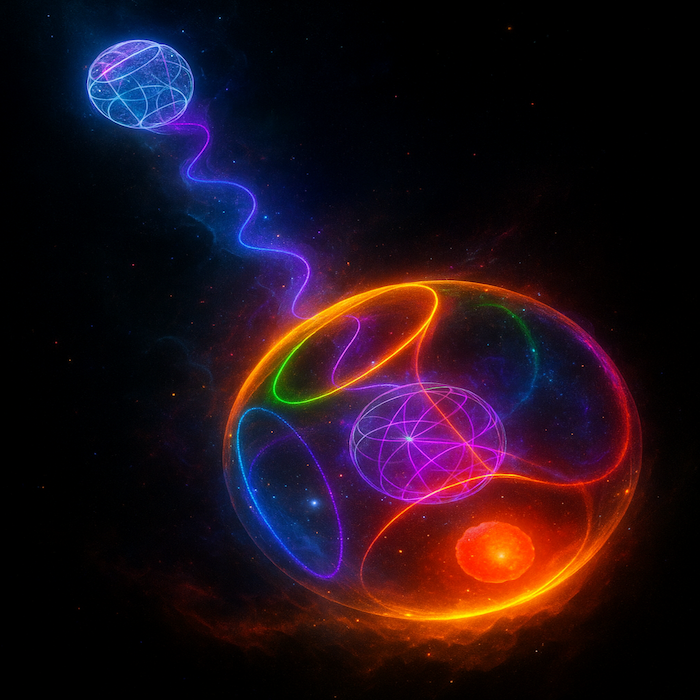
We well see interesting predictions regarding the ratio of protons and electrons in different atoms and isotopes.
Alpha-Particle read↗
The atom core has to allow a full symmetric rotation of two orbital electrons. Paired electrons need a co-axial rotation around a central nucleus. This needs a linear Electron-“Proton”-“Proton”-Electron coupling. Each electron couples individually to its own proton. So the linear Proton-Proton object in the atom core needs to be able to freely rotate virtually in all spatial directions. A symmetric compound is needed to fulfills this task. A compound, which hosts 2 “charged” particles which can entangle with 2 orbital electrons.
Why shall a huge proton have the exact same charge as a point-like electron? Well, now you know: it does not. Protons, Nucleons and Alpha-Particles are only heavy containers which keep electrons/positrons in place so they can entangle with the free rotating electrons in the orbitals. A container which holds charges in place via energy density repulsion still allowing them to rotate within the Alpha-Particles shell.
The alpha-particle is not simply an energetically favorable state - as simply observed and proclaimed by standard physics. It serves a specific purpose. It is a pre-requisite to enable electron-pairs to rotate around their entangled nuclei. The Alpha-particle is a necessity and prediction of the Roton-model. Fortunately it has already been discovered, named and nearly seen as an own particle with high symmetry even in standard and quantum physics. But with no glimpse of what is shall be good for.
We proudly present an (outdated but nice) illustration of an Olavian version of the Alpha-Particle. We choose a symmetric constellation of 4 Nuclei with 4 Sonons (3 Quarks) and 2 Pole-Caps conveying the charge itself. The so called Alpha Particle is a special combination of 2 electrons or positrons (if you prefer) confined in a cage built of the Quons (quarks) from 2 Protons and 2 Neutrons (equal to 18-20 Inter-Resonant quons). This $\alpha$ particle is the predominant basic building block of atom nuclei.
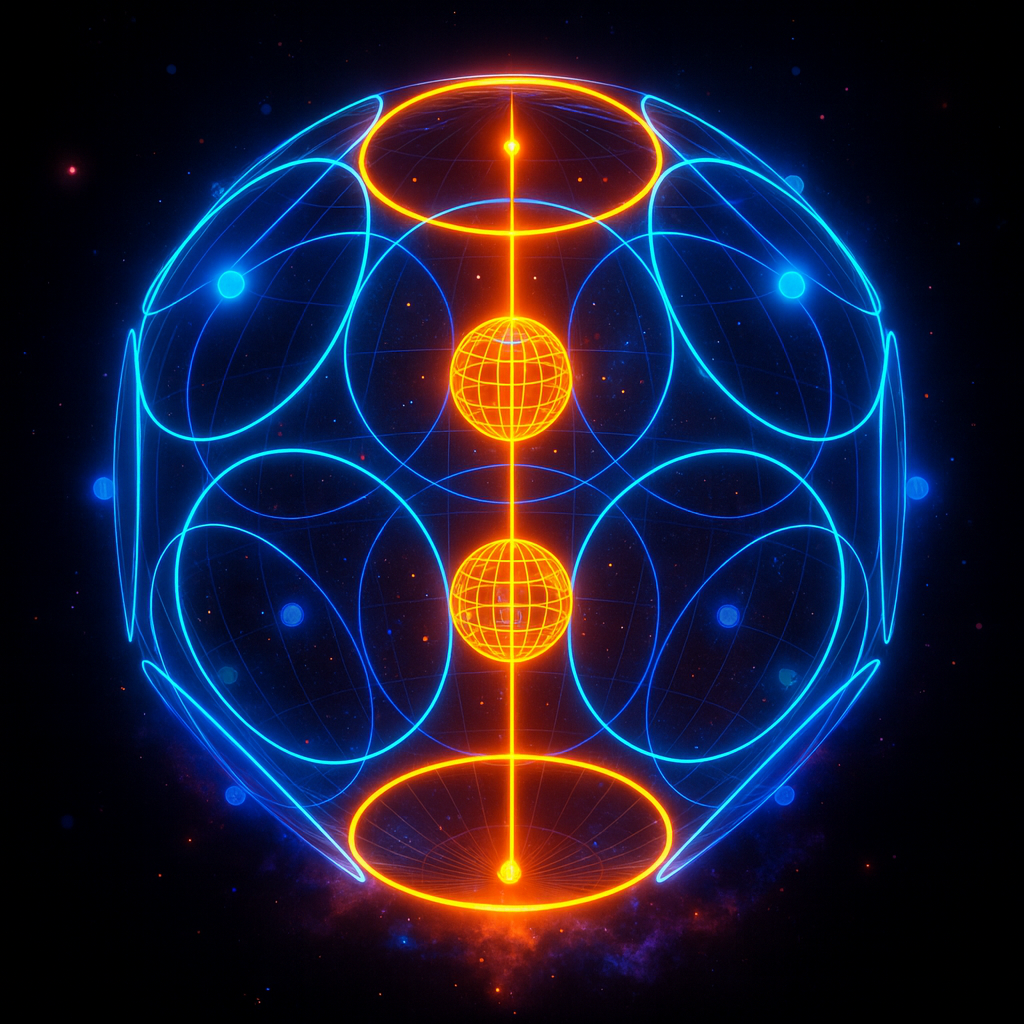
The alpha-particle keeps the electrons in line and holds them together so they can keep a more stable distance and resonance. This allows to attract free electrons even closer.
The question also arises, why atoms seem to be built from Alpha-Particles - 2 Alpha-Particles use more space then 4 Deuterium-Cores. Answer: Because an $\Alpha$ two internal charges (e+) can rotate freely, and 2 rotating Deuterium-Cores use more space - if they could ever rotate as fast around themselves.
Only one single unpaired valence-electron will entangle to single proton, deuterium or tritium nuclei. So stable atom cores are not expected to have more than one isolated proton P or deuterium D nucleus.
Alpha Simulations
In simulations we modeled N-Tier Rotons as Gridons together with some rotonal resonance coupling. After a longer time of trying to adjust number of nodes, starting energies, resonance-lengths, channel-counts it was possible to show, that the chosen structures for nucleus actually emerged as stable objects. Have fun watching some videos.

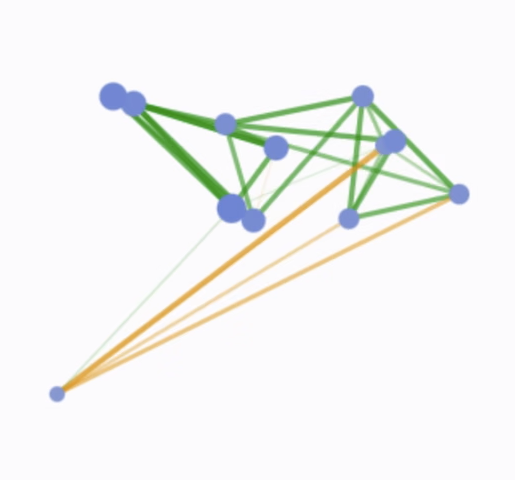
Nucleus Scattering read↗
This chapter is to simulate what happens if you throw an electron at a nucleus. Result: Well, you need to aim really good, otherwise it simply flies through.
Isotope Challenge 1 read↗
This chapter is to prove, that the Olavian Atom model can predict or at least explain the stable and unstable isotopes.
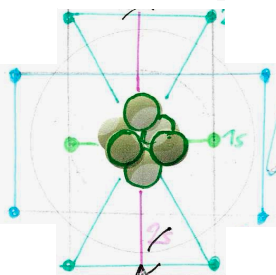 RQM Initial Nucleus Structure
RQM Alpha-Cluster NE-10 Core
Atom-Core Forces read↗
This short chapter describes how RQM sees the forces and resonance modes in the atom core. We will shortly compare the different forces in both standard and RQM model. We will see, that the same “kind” and “scale” of forces can be explained by the RQM model.
read↗
Isotope Challenge 2 read↗
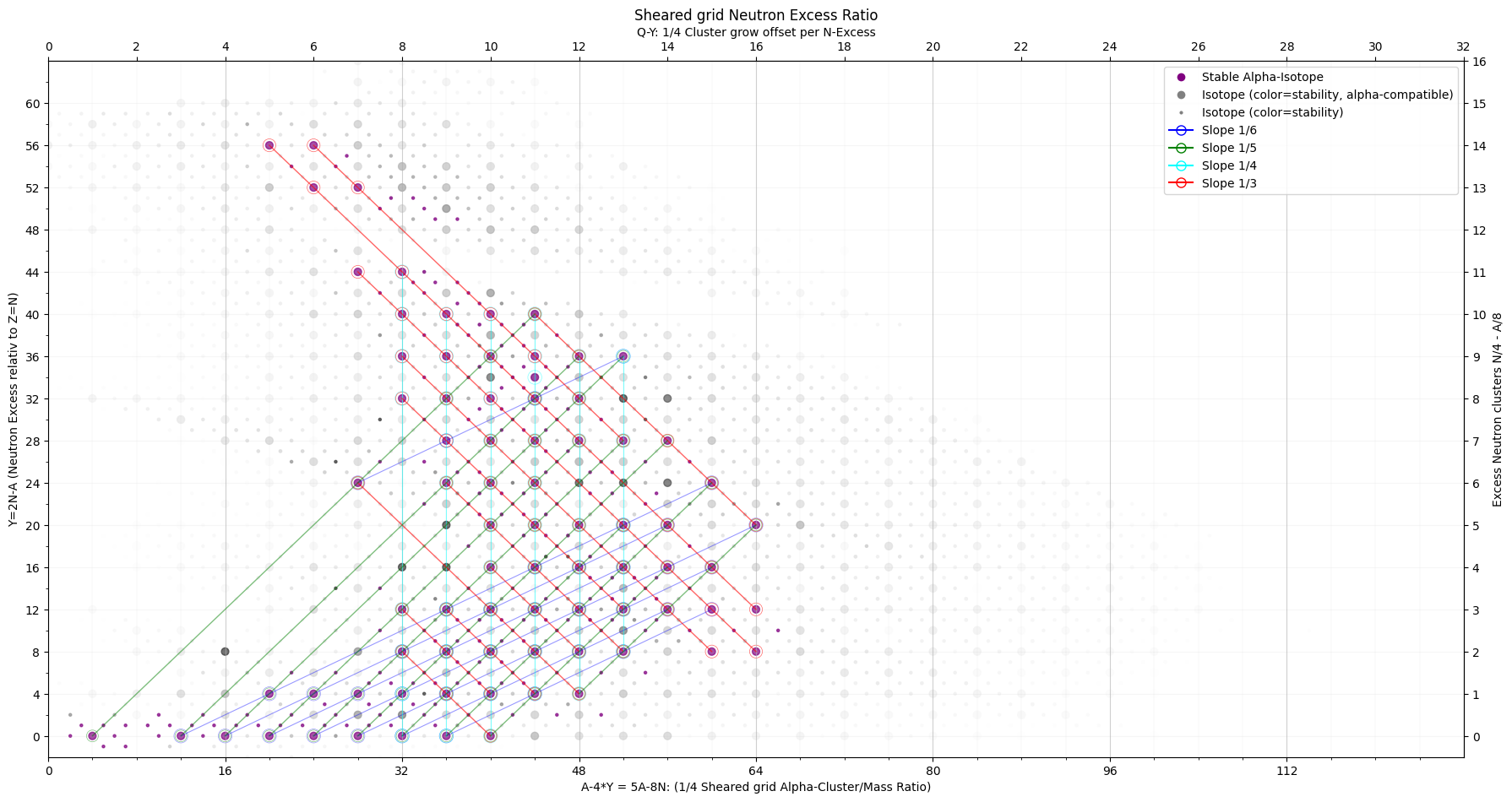
Before going into the full simulation, this chapter shows how to decode the structure of the isotope landscape. It aims at identify the growth structure of the Alpha-Like base briks called Q-Clusters. Q-Clusters are Proton or Neutron centered alpha-like 12-directional resonance clusters and visualized as dodecahedrons.
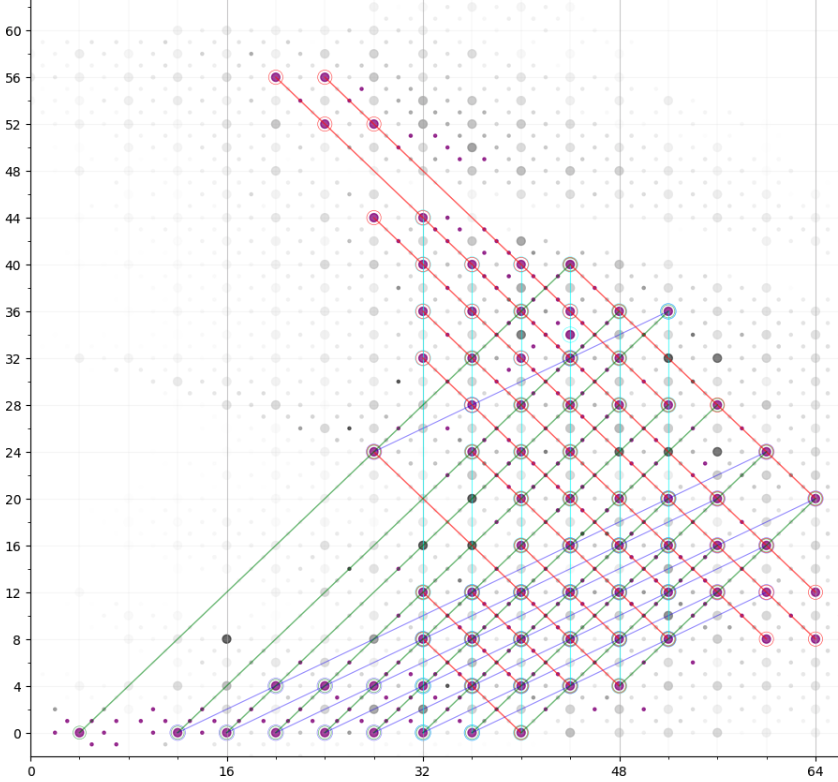 RQM Decoded Isotope Structure
Olavian Nuclear Atom Model read↗
After long analysis and visualizations of the isotope data maps the shell structure of the atom nucleus simply popped out for the Olavian Atom Model.
The Isotope map shows a clear 10/20 steps symmetry in the overall landscape in steps of: 12, 20, 10, 20, 12. This structare also pops out when looking at the width of proton-count Z for a given nucleus mass A.
RQM proposes Protons/Alpha-Particles to be the Fix-Points and Quons (Quark-like) to be the resonante parts between the fix points.
RQM modelles the energy and stability of the nucleus in terms of sequences of linear or mostly linear (frustrated) resonance-channel paths.
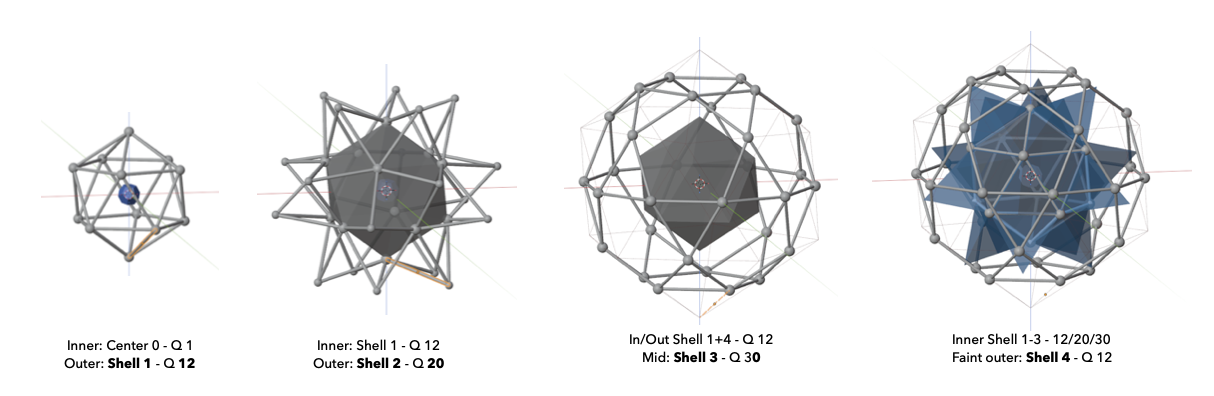
Sequence of OAM nuclear shells 1 to 4 with interconnection-grids
Analyzing the potential symmetries and icosahedral growth opportunities with equal distances but skewed angles automatically showed a perfectly identical structure.
Geometric Q-Grid Nucleon shell structure: with Q: 12/20/30/12 = $Q_74$ -> $A=296$. Where $A=294$ is the highest known (synthesizes atom mass number (Oganesson Z=118).
A=300 is Q_75 minus 2 center-axial Q gives a Q_73+2. Potentially 2 Missing axial Q’s + 2 Deuterons. The most stable has 15 Excess $Q_4^0$ so the outermost 12 are single-sided. And
This is exactly the highest possible symmetric ordering of Q-Span resonance structure with a frustrated center node and Z=118, N=176. 72 Q-Span, 58 Alpha + 58 Neutrons = 14.5 Neutron-Clusters
Isotope Simulation read↗
Let’s simulate how isotopes will grow with the RQM and compare it to the isotope and isomere landscape.
Quantum physics
Quantum Entanglement
We will demonstrate that quantum entanglement — particularly of photons and electrons — is a crucial factor in explaining why atomic nuclei hold together, and specifically why protons and electrons attract each other within atoms. To further explain certain phenomena with long-distance entanglement, we introduce the concept of bitemporal causality read↗: quanta are entangled because they always have been and ever will be entangled (within their lifespan). Both entangled twins share and remember their bi-directional future and past.
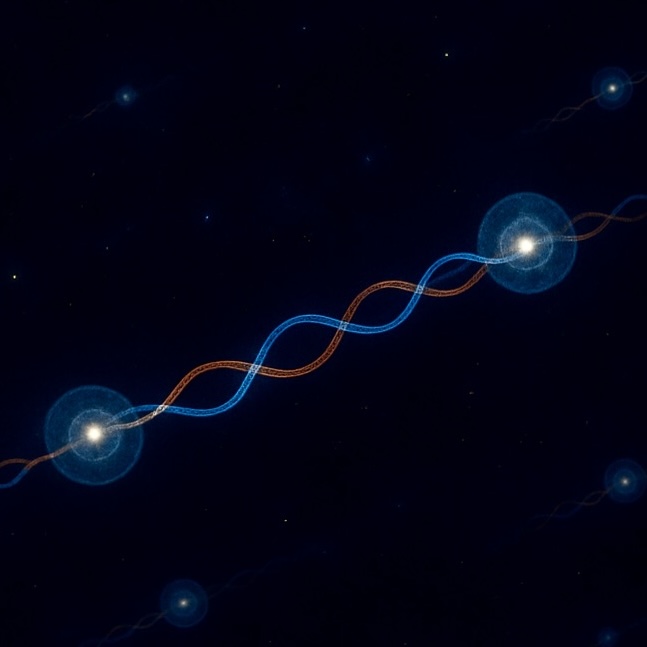
Measurability
For something to be observable by humans, it must interact with something humans can detect — such as light. This holds at least in the scales at which light can interact with Rotons the span of our atoms. However, on the scale of quarks and electrons, there is very little left which can be used to observe. We do not have anything even smaller to throw around. Observation always involves interaction. On this scale, every interaction destroys some of the original state. Thus, we can never measure the full state but only a statistical effect over many different measurements. This might lead to the conclusion that the even smaller components no longer interact with us directly. So we will never be able to directly “observe” any substructures. Still we can hope for the ability to trigger lower-level rotons to react via rotonal resistance (inertia) by manipulating and observing minimal state changes of higher level rotons and their coupling.
Decoherence (Collapse)
Decoherence of an entanglement denotes the breakdown of resonance alignment. Decoherence corresponds to the loss of phase-locked resonance channels due to uncontrolled coupling to external degrees of freedom. If a measurement or rather de-coupling is done on an entangled or hierarchical quantum, the full entanglement is destroyed. This might also mean, that these two quanta were never — and will never be — fully entangled. Two rotating entities with the exact same mode on a common rotation axis will be and remain entangled, due to increased resonances in axial direction. With this entanglement, small disturbances in orientation might even be stabilized. The entanglement breaks up if one quantum is forced out of its stable rotation axis strong enough. From this point on, entanglement will vanish, if the disturbance was too high. A disturbance on one of the entangled twins, might lead to a similar disturbance in the other twin. This is mainly the outside view of an underlying necessity for the bi-temporal character of a realized resonance entanglement. The resonance is not mainly an oscillation in space but also in time. Imagine a resonating violin string to be instantly made static - it won’t. So whenever it is static in the future it will start to get static earlier on.
Background fluctuations
Energy density optimization (phase adjustments) in the LEDO landscape is driven by its stochastic background fluctuations on different spans.
Dynamics of Energy-Density read↗
Physical systems continuously seek states of maximally phase-coherent energy density across all coupled scales. Any acceleration, structural change, or environmental gradient temporarily dilutes this coherence, forcing energy into internal re-organization before optimal density can be restored. The time required for this re-synchronization manifests as inertia, while its rate defines the local flow of time. Gravitation and relativistic effects emerge naturally as regions where energy density must constantly re-optimize within strained resonance conditions. … continue↗
Time is not a fixed dimension through which systems move, but the rate at which coherent energy-density states are successfully re-established.
Inertia is not a fundamental resistance of matter, but the persistence of energy trapped in non-optimal configurations during re-synchronization.
Space is not an empty container, but the effective room required for energy-density distributions to regain phase coherence.
Gravitation is not a force acting at distance, but the signature of sustained energy-density re-optimization within coupled resonance gradients.
Time as we perceive it in our macroscopic view, is not an independently flowing universal background. It is fundamentally defined by the oscillatory periods and phase relations of coupled energy-density structures such as electrons, photons, and their higher-order resonant compounds. What we call time emerges from the stability, count, and mutual coherence of these oscillations across interacting systems.
If, for any reason, the oscillatory period of an electron or photon shifts relative to surrounding structures, then its local sequence of states progresses differently. A slower effective oscillation corresponds to a slower progression of physical processes when compared to a distant reference system. In such a case, an unstable particle decays more slowly, a chemical reaction proceeds more slowly, and an object ages more slowly relative to an external observer. From within the system itself, however, all internal processes remain consistent, since all coupled oscillators adjust together. Time therefore cannot be regarded as globally uniform; it is inherently local and relational.
Within the RQM framework, no universal background time is assumed. Instead, physical reality is built upon locally defined oscillatory periods, their harmonic relations, and their phase coupling across multiple scales. What is measured as time corresponds to the count and coherence of these oscillatory cycles within a given environment. Temporal flow is thus a property of resonant systems maintaining phase alignment rather than motion through a pre-existing temporal dimension.
Where general relativity describes gravitational environments as curvature of space-time, RQM interprets the same observations as the consequence of phase de-coherence and re-synchronization within coupled resonance structures. Strong gradients and persistent accelerations disturb optimal phase alignment, requiring continuous internal re-optimization of energy density. This ongoing adjustment slows the effective progression of coherent oscillatory cycles and therefore reduces the locally measured rate of time. In this view, gravitational time dilation reflects not a geometric warping of time itself, but the energetic cost of maintaining phase coherence within a dynamically strained resonance field.
Space may be understood as the resolution mechanism of resonant systems confronted with phase mismatch. Read on↗ offers a more narrative exploration of this idea. In brief, space persists because not all systems can remain in complete harmonic alignment. Were perfect coherence universally attainable, the universe would long since have converged into a single global resonance. Instead, persistent mismatches generate separation, while locally stable extrema form coherent structures that prevent total harmonic collapse. Space thus appears as the dynamic consequence of incomplete resonance and the stabilization of many local equilibria within an otherwise unifying tendency.
Space marks the distance between systems that cannot yet resonate as one.
Spacetime Curvature
In Einsteins words “Geometry tells matter how to move”. But what tells geometry how to be, and why is spacetime not negatively curved where no big masses are?
Instead of making “spacetime curve” we say that “resonance-density gradients shape effective geometry”. The apparent size of the universe could reflect how much global coherence is missing. So empty regions behave as if space expands outward.
In this view, space does not curve around mass but emerges wherever systems fail to establish coherent resonance. Stable structures such as stars and galaxies form local resonance minima that draw surrounding dynamics into partial alignment, producing converging trajectories that appear as gravitational curvature. Yet regions lacking such coherent anchoring expand or remain extended, as no common phase relation constrains them. Space therefore reflects the unresolved portion of universal resonance rather than a fixed geometric background. Distances grow where coherence cannot be established and contract where stable resonance persists, suggesting that the apparent size and curvature of the universe may be a measure of its incomplete harmonic integration.
Gravity
:tendency toward coherent phase alignment
Space
:measure of unresolved phase difference
Size
A photon may carry essentially any wavelength and energy, yet electrons and atoms appear only within a narrow and well-defined spatial scale. Their characteristic size is not arbitrary, nor obviously tied to a single local parameter. Why should an electron, a proton, or even a quark possess precisely the spatial and energetic extent we observe?
In the rotonal view, the basic atomic and subatomic particles adopt their characteristic size because stable particles of a given type converge toward a common resonance scale. This alignment is not imposed locally but emerges from the oscillatory structure of the universal LEDO field. Within this background, it becomes energetically favorable for similar particles to occupy comparable spatial and energetic configurations, as only such alignment permits persistent and coherent coupling. Particle size therefore reflects global resonance compatibility rather than an isolated intrinsic parameter, with individual systems stabilizing where their internal dynamics best match the prevailing resonance environment.
The characteristic size of atoms is thus not determined solely by their internal Coulomb balance, but also by the requirement to maintain coherent resonance with the surrounding resonance potential field. Each element possesses its own internal structure of attractive and repulsive energy-density flows, yet stable atomic systems tend to contract or expand until their outer electron span remains compatible with the prevailing resonance scale. This leads to a narrow band of preferred atomic radii across otherwise very different elements such as Mg or Rn. Internal structure determines how efficiently this adjustment can be achieved, but the target range itself reflects an external coherence condition rather than a purely local equilibrium.
At first glance this may appear almost trivial: identical internal structures yield identical energies and therefore identical spatial extensions. Yet the picture becomes more subtle when one considers that the outermost paired-electron orbitals of most atoms occupy a remarkably narrow radial band of roughly 0.5–2.2 Å. Such uniformity across very different elements suggests that orbital shells may not be determined purely from internal structure alone. Instead, electron distributions may first settle into spatial ranges that remain compatible with the prevailing external resonance environment, and only then resolve inward according to the specific internal configuration of the atom. Atomic size thus emerges from a continuous optimization between internal energy-density dynamics and global resonance compatibility.
Antimatter read↗
This describes how electrons and protons anihilate into two photons.
It also describes how two photons can create matter, an electron and positron pair (e+/e-).
In RQM, a photon is a planar closed propagating sonon pair (s⁺s⁻), while electrons and positrons are stable three-dimensional confined resonance loops (s⁻s⁻s⁺ and s⁻s⁺s⁺), each consisting of three sonons.
γ = s⁺s⁻, e⁻ = s⁻s⁻s⁺, e⁺ = s⁻s⁺s⁺.
Take-Away: Antimatter is not different matter, it is matter with different composition of sonon handedness.
Antimatter asymmetry
The observed dominance of matter over antimatter suggests that creation processes in the early universe were not perfectly symmetric. Any viable model must therefore include mechanisms that introduce directional or phase asymmetries during formation, allowing one class of stable resonance structures to dominate over its mirror counterpart. In this framework, the observed predominance of matter can be interpreted as the consequence of an early arbitrary symmetry selection within the resonance field. Once a preferred rotational or phase orientation becomes locally established, subsequent creation processes no longer occur in a neutral background but within an already biased resonance environment.
Locality
Having said that reminds us about how to measure length. So if the basis of length is the size of e.g. a hydrogen atom, then yes, atoms have the same size in the whole universe. If the basis for length though is time (e.g. speed of light c) which is distance during a given time which again is a rotation duration of an electron in space well … I’d go with the egg not the chicken. If you define and measure the width of an electron by the circumference of an electron (time), well then all electrons have the same size - everywhere. So physics can actually not necessarily force neither local time nor local space to be uniform, linear or comparable in the whole universe.

Rotating entities create a directed resonance potential at which span (size, frequency) they can couple into the universal resonance-field. This will be described as inertia.
On basis of the Roton model, Inertia would be: resistance of a body to acceleration induced by another body. Or more precisely the resistance to change of rotation axis induced by LEDO-field resonances. Overall it is the sum of all energy placement, rotational attributes, attractions and temporal changes thereof between the two objects. And this all in a dynamic self-looped context. This might imply though, that a body has no universal inertia, but an inertia that depends on the source object. Acceleration depends on the sub-structure and sub-behavior of both objects. So the “weight” of the atoms listed in the periodic system might depend on the atomic composition of (e.g.) the earth. So in the optimal case, you as a reader already have a few experiments in mind to disprove this concept - maybe measure atoms on the moon?
Think of a Roton as a spring along its diametrical span. If a force starts to drag on one Sub-Particle, this will lead to some tension in the spring in either direction. Leading to squeezing, wobbling and precession of the rotonal path. This tension remains as long as the force applies. So any change of direction or force leads to a counter-force between the Twin and Twon roton. A force on the level of an atom span (gravity) will initially only influence the atom-span roton. But if that force changes, the Sub-Rotons need to adjust too. So they react on the first-derivative of the applied force (force change). This can be propagated downwards to the even smaller Sub-Rotons. In addition, this is also propagated upwards to the environment in the form of further resonances or temperature effects. The higher level environment reacts on it as an integral over the sub-states (e.g. as in a microwave oven).
Cosmic structures
Before we start on what existing things at cosmic scales might be in RQT, let’s have a look at what RQT would say about space and projections at huge scales.
NEW: Round table on galactic scale resonances
Galaxies modeled as Rotons in space may form stable flowing and pulsing structures. On cosmic scales, these appear as filaments.
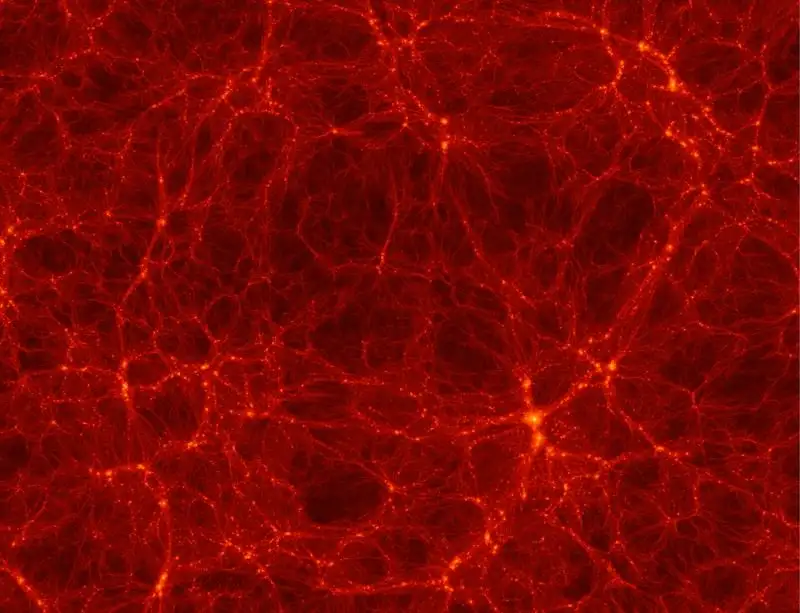
RQT view: The large-scale universe resembles a resonance sponge rather than a homogeneous continuum. At cosmic span, rotational hierarchies can no longer confine the residual resonance requirements of matter. A different closure strategy becomes necessary, and network structures again enter the stage, much as they do on nuclear scales.
A sponge-like structure offers a sparse and efficient solution: most of space remains only weakly constrained, while unavoidable resonance mismatch is concentrated into comparatively small volumes of filaments and nodes. Matter accumulates preferentially along these structures because they satisfy the underlying resonance requirements, rather than creating those requirements themselves.
RQM view: Galactic filaments may be modeled as large-scale resonance links between galaxies and galaxy clusters. Their stability could emerge from compatible orientations, rotational axes, and oscillatory phases across the network. Coherence would then reflect global resonance agreement rather than continuous causal transport along the filament.
The cosmic web may therefore represent an optimization of large-scale resonance closure: residual mismatch is geometrically confined so that the overwhelming majority of cosmic volume can remain comparatively coherent.
This suggests that the universe does not merely contain long-term stable structures. Its organization continuously favors them, since only structures compatible with the wider resonance landscape can persist.
Size of an atom - cosmic oscillations read↗
Why do atoms have the size they do? Why do stable orbitals emerge at specific distances?
One cannot ignore the possibility that space-time is permeated by a residual, coherent background hum rather than purely random fluctuations. Such a background would not be arbitrary; it would carry preferred spans and frequencies shaped by common resonance conditions. Because atomic-scale systems are ubiquitous, their characteristic resonances would collectively imprint themselves onto space-time, forming a persistent background field. This field, in turn, provides a set of naturally available resonance channels.
Atomic structures may then not choose their scales freely, but instead settle into configurations that align with these shared harmonic channels, resulting in stable orbital distances through a form of resonant lock-in. Beyond gravitational interactions at fundamental scales, there are indications that such background structures exist. On cosmological scales, a nearly uniform radiation field can be observed, originating from earlier stages of the universe. While not identical in mechanism, it demonstrates that large-scale, persistent background fields can emerge and permeate space-time.
Evidence for persistent background structure comes from the existence of the cosmic microwave background (CMB) read↗. This nearly uniform radiation field permeates all of space and establishes a thermal baseline: objects in intergalactic space tend to equilibrate toward its temperature of approximately 2.7 K. The CMB is not directly tied to atomic scales, nor is it identical to the proposed background resonances. Rather, it represents a frozen imprint of an earlier equilibrium state of the universe. Its persistence demonstrates that space-time can carry coherent, long-lived background structure across vast scales.
With this in mind, structures in space-time will tend to settle into resonant lock-in with shared harmonics. Rather than remaining arbitrary, resonant modes drift toward and stabilize within common resonance channels. Existing systems do not evolve in isolation: they continuously adjust to the residual background of available resonances. In this sense, resonance channels act as constraints that cannot be freely ignored without loss of coherence with the surrounding structure.
Resonant modes therefore self-organize into shared harmonic states. This process enforces a form of harmonic agreement, where stable configurations correspond to alignment with these common channels. Modes that fall outside such harmonics lose coherence and gradually decouple from the structures that define matter as we observe it.
At the same time, certain configurations may act as bridges between distinct resonance regimes — linking scales such as subatomic structures, atoms, and galaxies. Through such transpositions, the universe may host a spectrum of harmonics that are locally distinct yet globally connected.
Voids as the Dominant Optical Medium
Gravitational lensing is usually attributed to mass: stars and galaxies bend light inward and focus it. Yet on cosmic scales most of the universe consists of vast voids, not dense structures. These regions contain far less matter than average and therefore act as weak diverging lenses. Light passing through them spreads slightly outward, producing subtle de-magnification and shear that can be measured statistically across large sky surveys.
The universe thus behaves as a network of both lenses and anti-lenses, with light continuously guided by gradients of structure across immense distances. Interpreted more broadly, massive systems may represent regions of strong local coherence that draw trajectories inward, while voids mark regions where such coherence is absent and paths naturally diverge. In this sense, the large-scale geometry of the cosmos may be shaped as much by its vast regions of low coherence as by the structures that condense within it.
In the rotonal view, matter represents persistent local disturbances within the universal resonance coherence, structures that maintain their identity by continuously negotiating phase mismatch with their surroundings. Around such enduring resonance knots, additional “space” is required to accommodate incomplete alignment, and trajectories curve toward these stable centers. Vast voids, by contrast, contain little that resists global coherence. With fewer persistent mismatches to sustain separation, the need for extended spatial buffering diminishes, and effective trajectories gently diverge as the background approaches a more uniform phase condition. In this sense, matter marks regions where coherence cannot fully settle, while voids reveal where the universe comes closest to its undisturbed harmonic state.
Black holes and spacetime curvature read↗
Black holes are a fascinating object in the universe. They kind of decouple causality and resonance coupling between internal objects from external objects. So effectively, from outside view they might internally rotate at much faster speeds than typical, even faster than light. On universal scale, they act like “resonance voids” where all resonanance coupling vanished. The hole as a sphere might draw in electrons in a spiraling way, and release a compensating field in axial direction with all associated magnetic effects. Gravity might still remain and mainly associated with the spherically rotating not yet decoupled matter. How would a “void” react on matter? It would effectively rather function repulsively, missing the attraction from sourrounding matter in a specific direction - while still be attracted by the already circling matter. At the event horizon though, there might exist an equilibrium on loosing central gravitational attraction in combination with electrical attraction.
Big masses lead photons into curved paths. Instead of bending space and time to explain this effect, the Roton-Model explains this quite naturally with residual attractive resonances. These from global view lead to a slow-down of rotational periods of objects. Even though a photons rotation is purely planar, random background fluctuations still expose it to minimal inertia. Is there any place where field fluctuations cease entirely? You could imagine the infinity of the universe being like the singularity of a black hole, inverted and point-mirrored. The closer you get the slower you become, atomic processes slow down, time starts to pass slower and slower. You will never reach the center or in this case infinity. The fade out of fluctuations and asymmetric alignment of resonance potentials at this rotonal scale prevents any further motion. The universe is the final Roton caught in self-resonance, from where nothing will ever escape.
Block holes might be objects that re-open bi-temporal causality to galactic scales. They serve causal accessibility while preserving global consistency. A black hole does not transport information forward in time, but enforces consistency across time. This makes it a natural anchor point for backward-compatible resonance structures. In this sense, Galaxies do not fall into black holes because they are attracted. They remain because incompatible futures quietly cancel themselves out. A black hole does not amplify nor return resonances.
It silences time, until only globally consistent modes remain. In bi-temporal causality, the universe does not correct itself. It simply refuses to realize inconsistent histories.
Black holes may function as bi-temporal boundary structures, suppressing local decoherence and enabling global resonance agreement across cosmological scales. In this view, large-scale coherence phenomena such as galactic filaments are not dynamically enforced but selectively permitted: only matter configurations compatible with both past formation and future consistency persist. No information is exchanged across time; instead, incompatible trajectories fail to establish resonance existence. Black holes thus act not as causal engines, but as temporal silencers, allowing only globally consistent modes of structure to remain.
A “temporal node” in a resonance network is a system which participates in resonance agreement across time, not along time. A “Temporal node” strongly suppresses accessible micro-states, reduces effective temporal degrees of freedom and enforces boundary conditions across time. Or in other words, if you reverse time at a black hole, a galaxy could pop out as a whole and this would not contradict causality.

About Life, the Universe, and Everything
From what we have seen so far, it becomes difficult to escape a simple conclusion: the universe, from its smallest oscillations to its largest structures, must tend toward long-term stability — because anything that does not, simply does not persist. It has already converged to a form that preserves itself, one that neither decays nor collapses into nothing.
The universe does not fade away. It has already settled into what remains.
With all these teasers, you are invited to dive into the details presented on this website as the “Roton Quantum Model” to see how easily this model explains complex behavior — even in areas where modern standard physics has yet to provide answers.
Yours, Olav le Doigt
Glossary read↗