Chapter 1 — Conceptual Model of Isotope and Isomer Landscapes (A > 20)
Structure of Isotopes and Isomers (RQM-inspired)
We dive into the world of atom-cores looking at different aspects of the isotopes and isomers.
The target is to identify structure, which relates to the OAM (Olavian Atom Model) or in other words prove that the OAM model and predictions hold.
1. Foundation
1.1 Background and Conceptual Basis
Atomic nuclei are not treated as rigid objects, but as dynamic, discrete resonance structures evolving within a fixed mass space:
$$
A = Z + N
$$
These structures emerge from lattice-like arrangements consisting of:
- fixed nodes (charge-bearing centers)
- oscillating nodes (energy-bearing resonance units)
Oscillating nodes tend to close their outward resonance channels efficiently.
The residual component contributes to large-scale effects (q-scale), while the dominant internal structure is governed by:
- directed resonance channels originating from fixed nodes (e-scale)
These fixed nodes allow coupling through open resonance channels on e-span level.
In standard terminology, this manifests as electric charge.
Conceptual mapping:
| RQM-like interpretation |
Standard analogy |
| fixed node |
charge carrier (≈ proton-like) |
| oscillating node |
main energy unit (≈ quark-like) |
Oscillating units tend to appear in triplet formations, enabling stable spatial configurations in 3D-space through compatible orientations with fixed nodes.
A stable node is required to link to 3 oscillatory paths otherwise it will not remain stable at that location.
Isotope landscape Z/A
Instead of the usual Z/N landscape we move to the Z/A landscape. This is vital as A gives the basis for the main structure and Z is only a sub-aspect of it. A sub-aspect in respect of the core, not in respect to the whole atom.
Be invited to investigate the map of atom isotopes in even-even Z (proton) - A (mass) view instead of the typical Z (proton) - N (neutron) view. Mind that only around 1-3 isotopes exist for each mass unit. The main dots show the stable isotopes, where-as the z-axis value indicates decay rate stability. For each core-structure of a given energy (A) one or maybe two of the variations of the number of fixed nodes is the most stable one which will eventually be reached (Beta- and Beta+ decay).
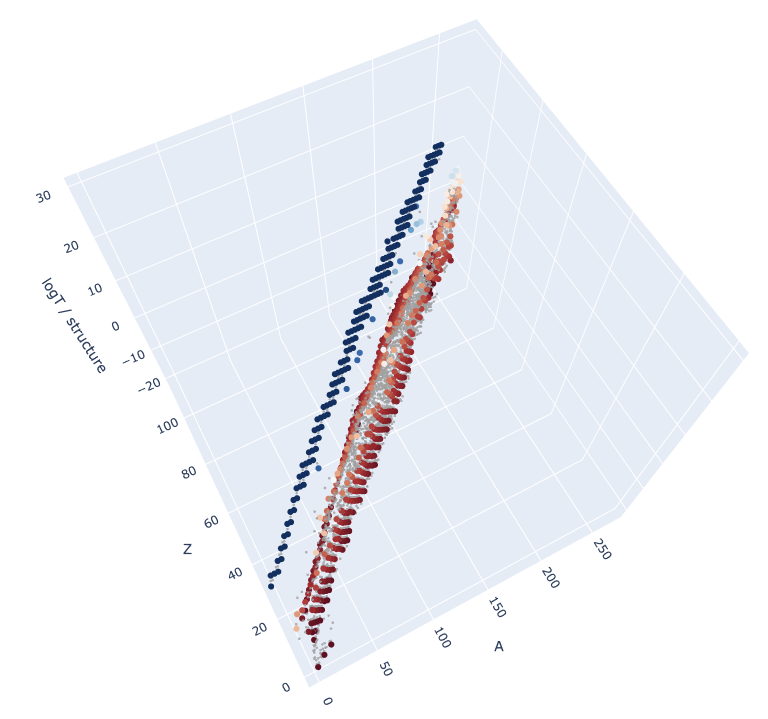
Interactive isotope map
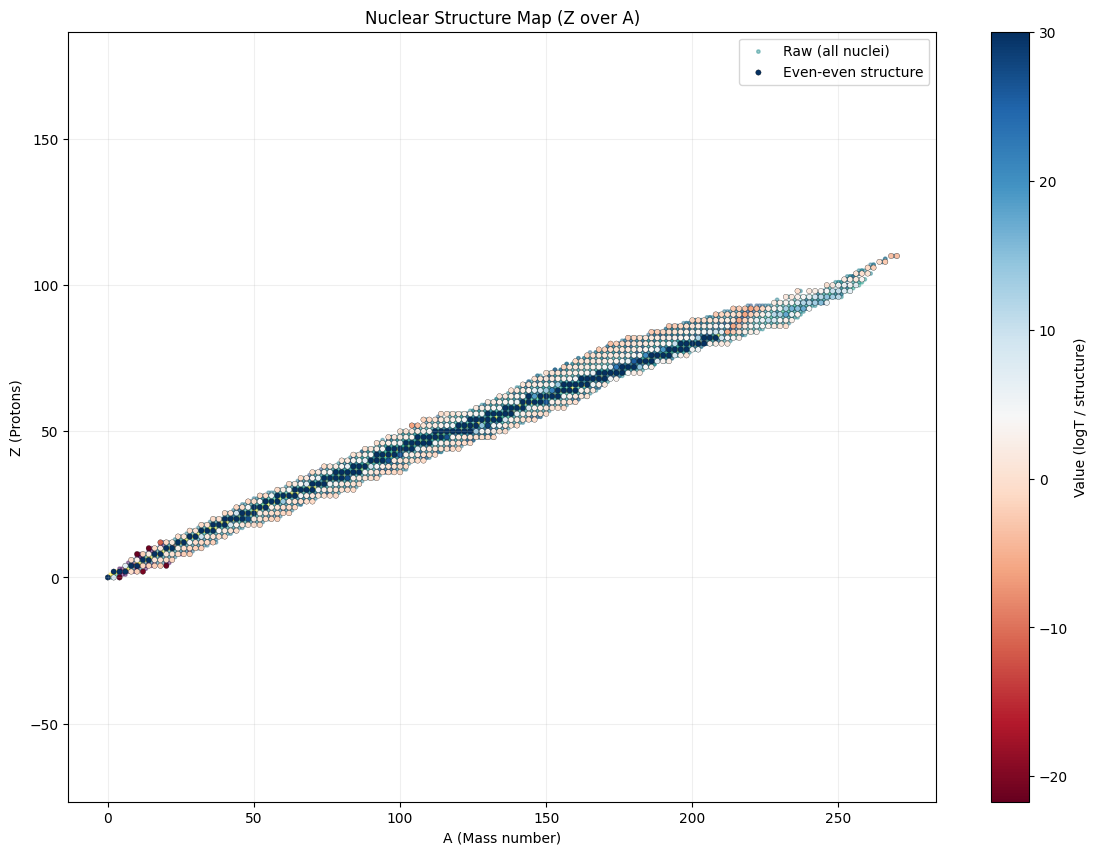
Static isotope projection
Isotope decay stability (log T) per Mass (A) and Charge (Z)
Isomere landscape
The following diagrams show isotopes/isomeres once in respect to their decay rate stability and once in respect to their energy stability (energy needed to separate the core nuclei). We see the lines of stability were we see more and less stable isotopes. This gives a clear insight on the regions where more stable structures are to be found.
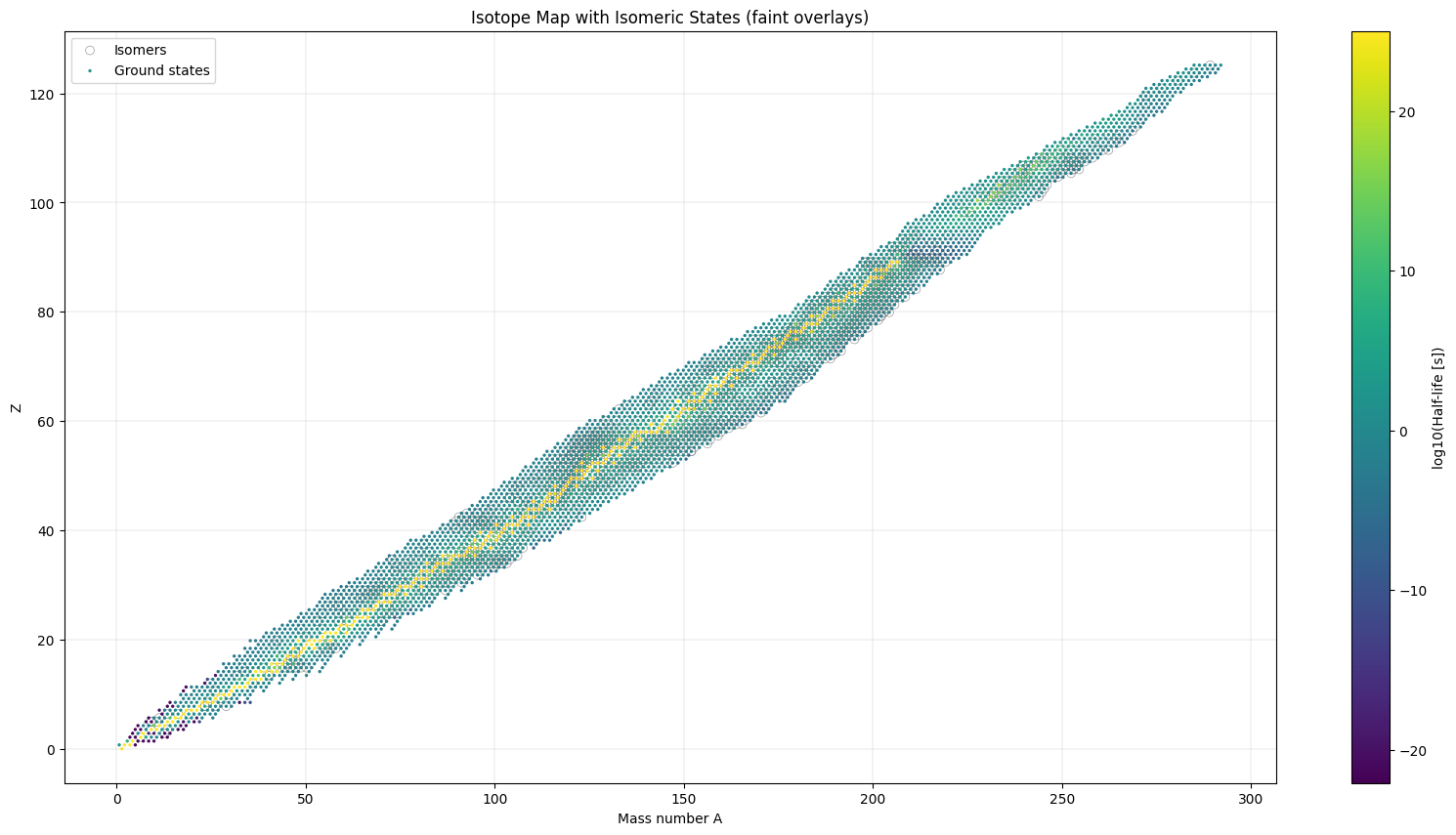
Isotope decay stability (log T) per Mass (A) and Charge (Z)
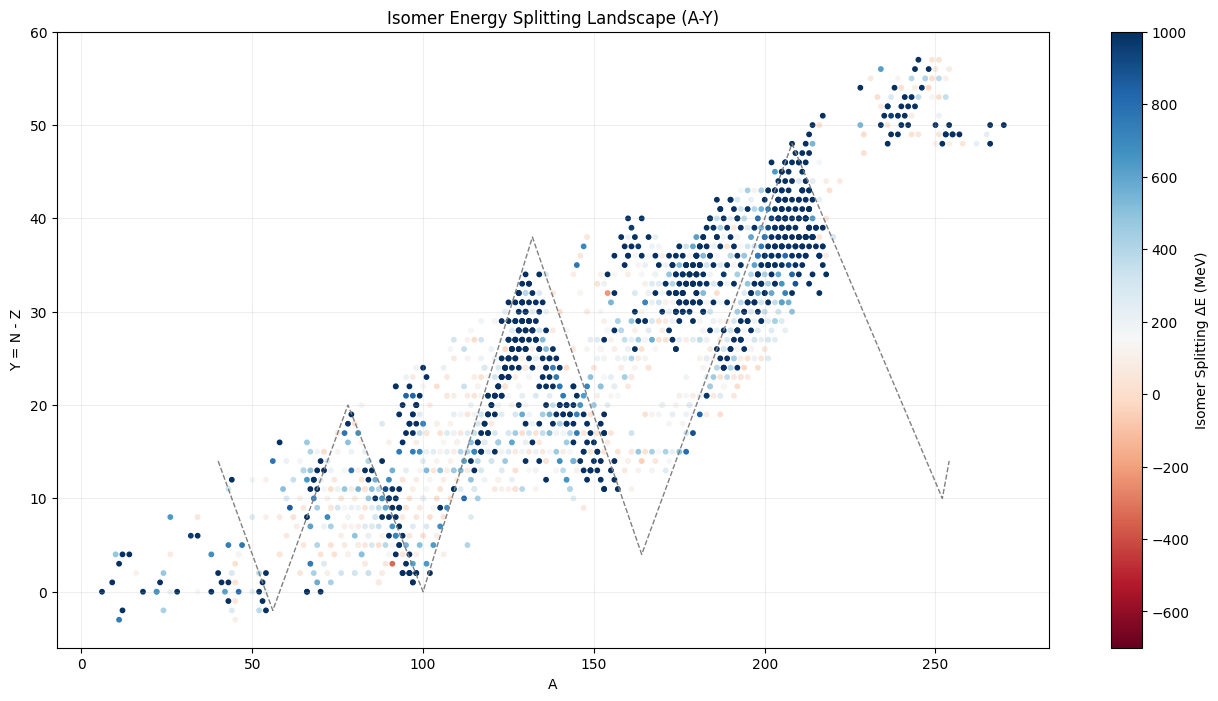
Average Isomere Holding Energy Map per (N-Z)/A
Decay rate (T) versus Energy-Delty (Delta-E)
Diagram-Source: Olav le Doigt (2026)
Data-Source: “Nubase2020 citation: F.G. Kondev, M. Wang, W.J. Huang, S. Naimi, and G. Audi, Chin. Phys. C45, 030001 (2021)"
Fixed Node Range per A
Lets have a look at another revealing insight regarding how many variations of Fixed nodes an isotope has. Or in other words how many ways of different Proton<->Neutron distributions can be observed.
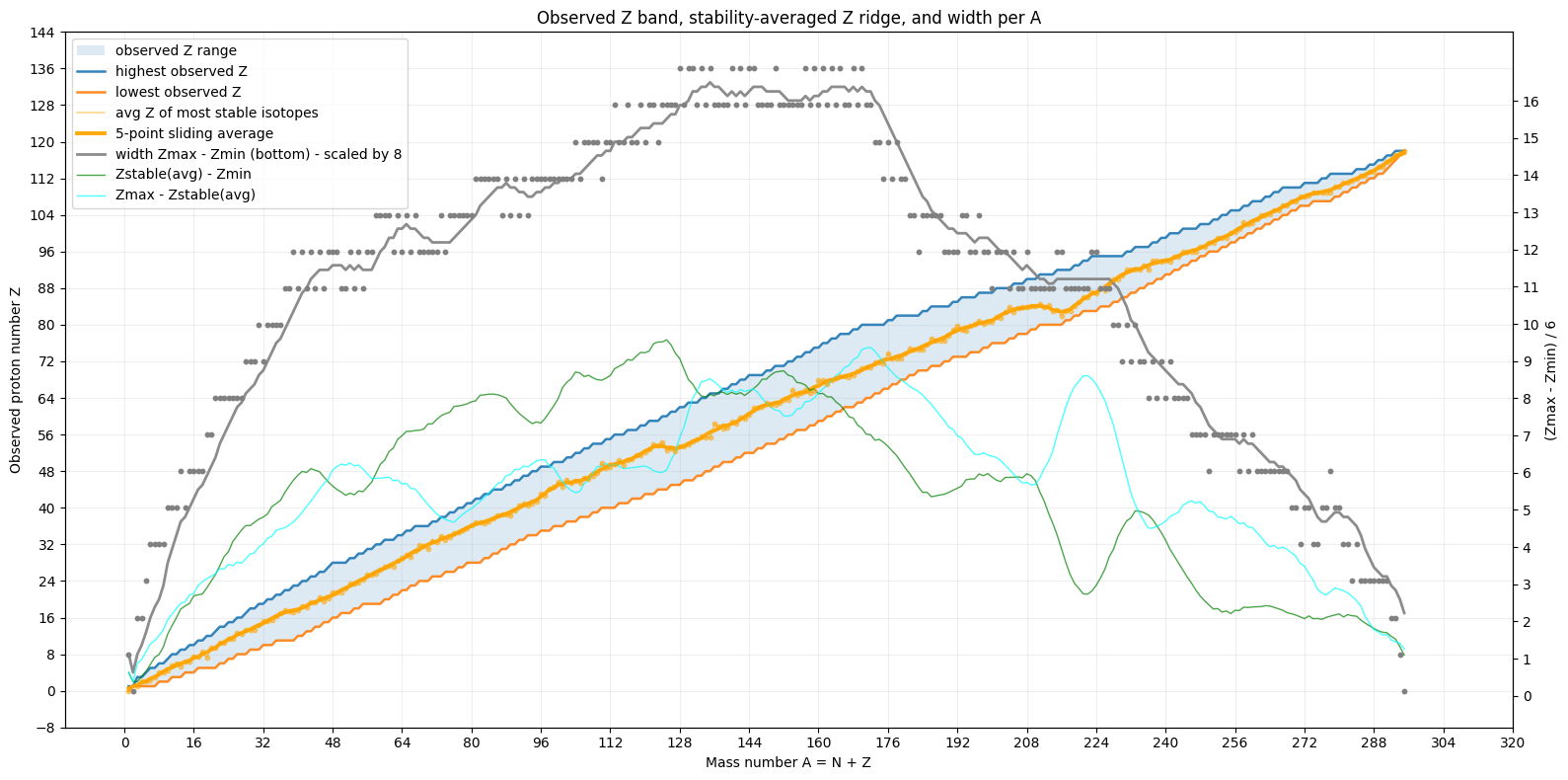
Fixed-Node range (P/N) per A
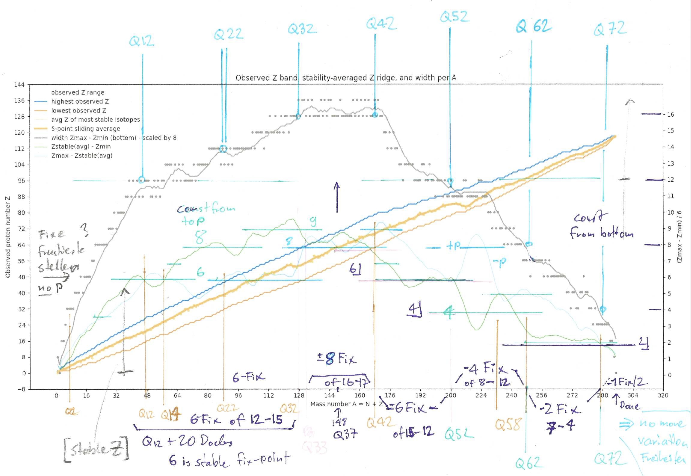
Fixed-Node range (P/N) per A - manual marks
Range of Proton/Neutron flip and most stable ratio over A. Overlapping a Z/A Plot.
Marks showing the growth chunks (at A=2+Chung*20), the delta-Z range per chunk and stable-Z ratio.
What can we see:
- Growth of the nucleon cluster runs in chunks of $\delta A = 20$
- $\delta Z$ values maximize at around 16/17 and have a special grouping at around $\delta Z = 12$
- Rising from A=48 to A=128 the most stable variations have a Z-Distance of $Z_d=6$ to the upper edge ${deltaZ}_max$
- There is a peak plateau from A=129 to A=168 with around $\delta Z=16$ and stable point at $Z_d=8$
- On the $\delta Z$ downwards slopes we also see the stable $Z_d = ${\delta Z}/2$ but this time with the distance from the lower edge.
What does the OAM (Olavian Atom Model) tell about it:
- Clusters grow in groups if 5-Q rings (alpha-cluster like), which gives blocks of $\delta A = 20$
- A Q12 core can have a maximal variation of $\delta Z = 12$ fixed points. A Q32 core limits at $\delta Z = 16$
- A Q12 is a fully symmetric 12-Dode sphere. Each Q can have 1 or 2 fixed charges giving the range of 12. The most optimal at $\delta Z=6$ below $Z_max$.
This means a further growing Q12 cluster adds variability. So a Q12 can have 6-Protons less corresponding with going down with protons until we reach halve of the cluster (12).
Going further down would allow a different better stacking charge-wise as full Q6. In upward direction we can add 5 or 6 more fix-points.
For each Q5-block added (mass), we have 2 more possible stable Z-Points.
- … Q38
What is this telling us:
- Symmetry in respect to charges is crucial for stability
- Symmetry in respect to mass is important for stability
- Symmetry is based on single axial symmetry (most likely atom-core spin).
- This is why stable clusters grow in groups of 5 in respect to charges.
This corresponds to the predictions of the OAM.
1.2 Base Model of the Nucleus
A nucleus is modeled as:
- a set of nodes (fixed points)
- connected by resonance edges (energy channels)
Constraint:
Each node supports up to 12 resonance channels, arranged in up to 6 spatial directions (bidirectional).
1.3 Small Nuclei
Small nuclei can form stable configurations with limited directional channels:
- for instance 2 resonance channels per 3 direction (isolated Proton, Neutron)
- resulting in simple geometries (e.g. dipyramidal forms)
Intermediate structures expand into:
- multi-directional coupling (up to 6 directions)
- geometries approximating icosahedral lattices
- emergence of alpha-like cluster motifs
Relevant cluster counts:
$$
1,\ (2),\ 3,\ 4,\ 5 \quad \text{clusters}
$$
with optional neutron-like additions internally or externally.
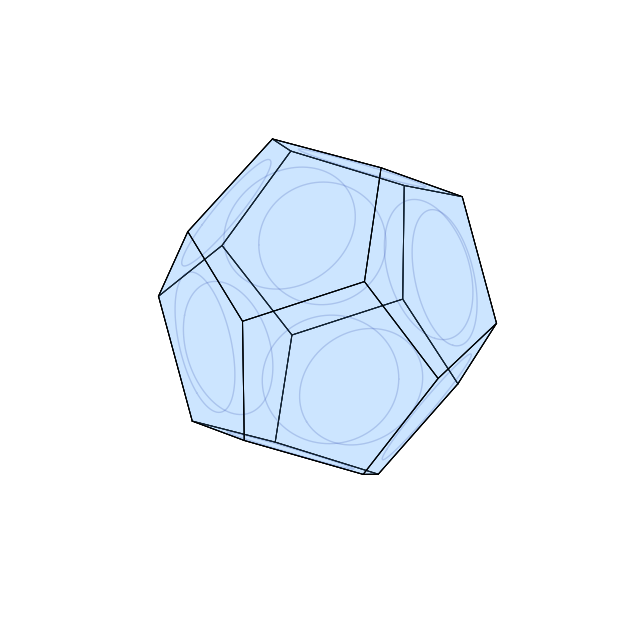
Alpha Dodecahedron - faces representing q-span rotons
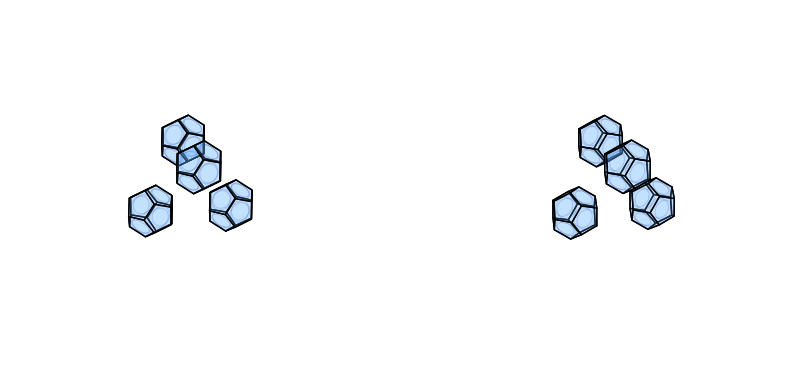
4 Alpha resonance cluster (O-16) - in Stereo
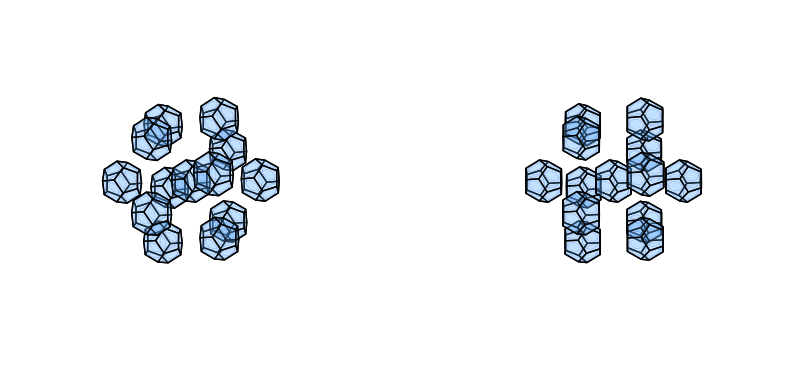
10 Alpha (2-Ring) plus 0-4 Neutron axis core cluster (Ca-40 to Ca-44) - in Stereo
1.4 Larger Nuclei
For larger systems, geometric frustration becomes unavoidable:
- space cannot be perfectly tiled with dodecahedral/icosahedral units
- mismatches in angles, distances, and connectivity appear
This leads to:
- incomplete closure of resonance channels
- competing structural arrangements
- emergence of non-trivial stability patterns
But:
- There is no need for real dodecahedral or icosahedral tiling.
- RQM lives from linear coupling between Quons and not from exact angles of the Quon directions.
Result:
It is ok to visualize further Quon interactions as vertices.
It is ok to visualize further Fix-Nodes (Alpha-Centers, Q-Centers) as nodes.
We will omit the rotational aspect and simply show a Q-Span Interaction-Channel as edge.
A single Node can be: Empty ($Q_4^0$-Center), Charge 1 ($Q_4^1$), Charge 2 ($Q_4^2$)
1.5 Full Nucleus Model - SPOILER
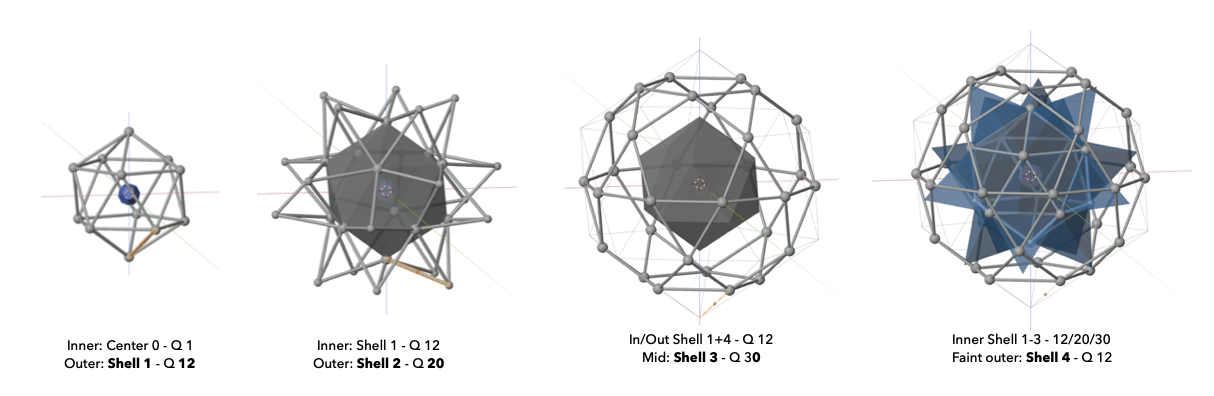
Sequence of OAM nuclear shells 1 to 4 with interconnection-grids
4-Shell Olavian Nucleus Model Q-Grid
2. State Space of an Isotope
2.1 Nuclear State
A nucleus does not correspond to a single configuration, but to a family of possible states:
- topology (geometric arrangement)
- local occupation (proton-like, neutron-like, vacancies)
- symmetry (axial, point symmetry)
- internal tension (“frustration”)
Conceptual representation:
- fixed charge nodes (e⁺-like)
- resonance units (q-like)
Standard analogy:
- neutron → neutral resonance triplet
- proton → resonance triplet with additional charge-node
2.2 Model States
For a given $(Z, N)$, many configurations exist:
$$
S_i(Z,N), \quad i = 1 \dots \mathcal{O}(10^2 - 10^3)
$$
These correspond to:
- ground states
- excited states
- isomers
- transient intermediate configurations
👉 An isotope is therefore not a single structure, but a minimum within an energy landscape.
3. Stability as a Relative Concept
A nucleus is not absolutely stable, but:
- stable if no energetically better configuration is reachable nearby
- stable if external resonance channels are largely closed (symmetry)
Implications:
- decay = transition toward a more optimal structure
- isomers = local minima separated by barriers
- unstable nuclei = accessible lower-energy configurations exist
Asymmetry leads to:
- increased coupling to external systems (e.g. electron orbitals)
- internal torque and precession effects
4. Families of Structural Types
For $A > 20$, nuclei can be grouped into structural families.
4.1 Terminology
Terminology:
- We use the term Q for a structure-paticle of 4 Nuclei. This is either NNPP or NNNN.
- We use the term $\nu$ (Nu) for a $NNNN$ nucleon cluster. Similiar to the established term $\alpha$ (Alpha) for NNPP nucleon cluster.
- We use the term dode (for dodecahedron) as a general space geometric reference for an $\alpha$, $\nu$, NP (Deuteron), NN compound.
- We use a $Q_a$ subscripted by $a$ to indicate a cluster compound consisting of a Q-Elements.
- We use a $Q_a^n$ superscripted by $n$ to indicate the number of $\nu$ elements.
4.2 Center structure
Example central core cluster families:
- 1-Alpha like center (dode-centered)
- 2-Alpha like center (face-centered)
- 3-Alpha like center (edge-centered)
- 4-Alpha like center (point-centered / tetra-like)
Derived core structures:
- 5-Alpha ring (empty center) - $Q_5^0$
- 10-Alpha double-ring (empty center, +2N) - $Q_{10}^0$ to $Q_{12}^2$
- 12-cluster shell (icosahedral shell, empty center) - Typically with 2 $\nu$ as side-positions (due to frustration)
- Potentially: 20-cluster shell (filling spaces between 10-Alpha double-ring) - $Q_{22}^2$
Comments:
-
center sphere position seems too small for an Alpha so it might stay empty or filled by a $\Nu$ in case the sides continue.
-
shell-like or partial-shell extensions, 12-shell dode seems to need $\nu$ at the sides to patch frustration
-
hierarchical structures (core + outer clusters)
-
$Q_{0}^0$ is the last fully stable isotope with no Neutrons and fills up a double dodecahedron ring.
-
$Q_{17}^2$ fills up the 3x5-ring-dodecahedron shell with 2 side neutrons.
-
$Q_{22}^2$ fills up the 4x5-ring-dodecahedron shell with 2 side neutrons.
Each family is defined by:
- preferred geometry
- symmetry axes
- defined docking sites
- characteristic frustration behavior
👉 The inner isotope landscape emerges as additions of $\alpha$, $\nu$, P, N to the listed cores as intermediat growing.
4.3 Layer Q>22 structure
Starting from there we enter the world of extension families:
- Slope 1/6: $Q_6^1$-Line with one $\Nu$ and 5x$\alpha$ per 6 $Q$
- Slope 1/5: $Q_5^1$-Line with one $\Nu$ and 4x$\alpha$ per 5 $Q$
- Slope 1/4: $Q_4^1$-Line with one $\Nu$ and 3x$\alpha$ per 4 $Q$
- Slope 1/3: $Q_3^1$-Line with one $\Nu$ and 2x$\alpha$ per 3 $Q$
- Slope 1/2: $Q_2^1$-Line with one $\Nu$ and 1x$\alpha$ per 2 $Q$
- Slope 2/3: $Q_3^2$-Line with two $\Nu$ and 1x$\alpha$ per 3 $Q$
👉 The outer isotope landscape emerges as additions of subclusters.
More precicely:
- $Q_5$-ring with a closing side $\nu$ docking to a free Alpha
- $Q_4$-cap attached to a sink via a $\Nu$
- $Q_3$-cap attached to a sink via a $\Nu$
- (Symmetric 2x$Q_3$-cap each attached with one NN)
4.4 Q-Structure and slopes in isotope-landscape
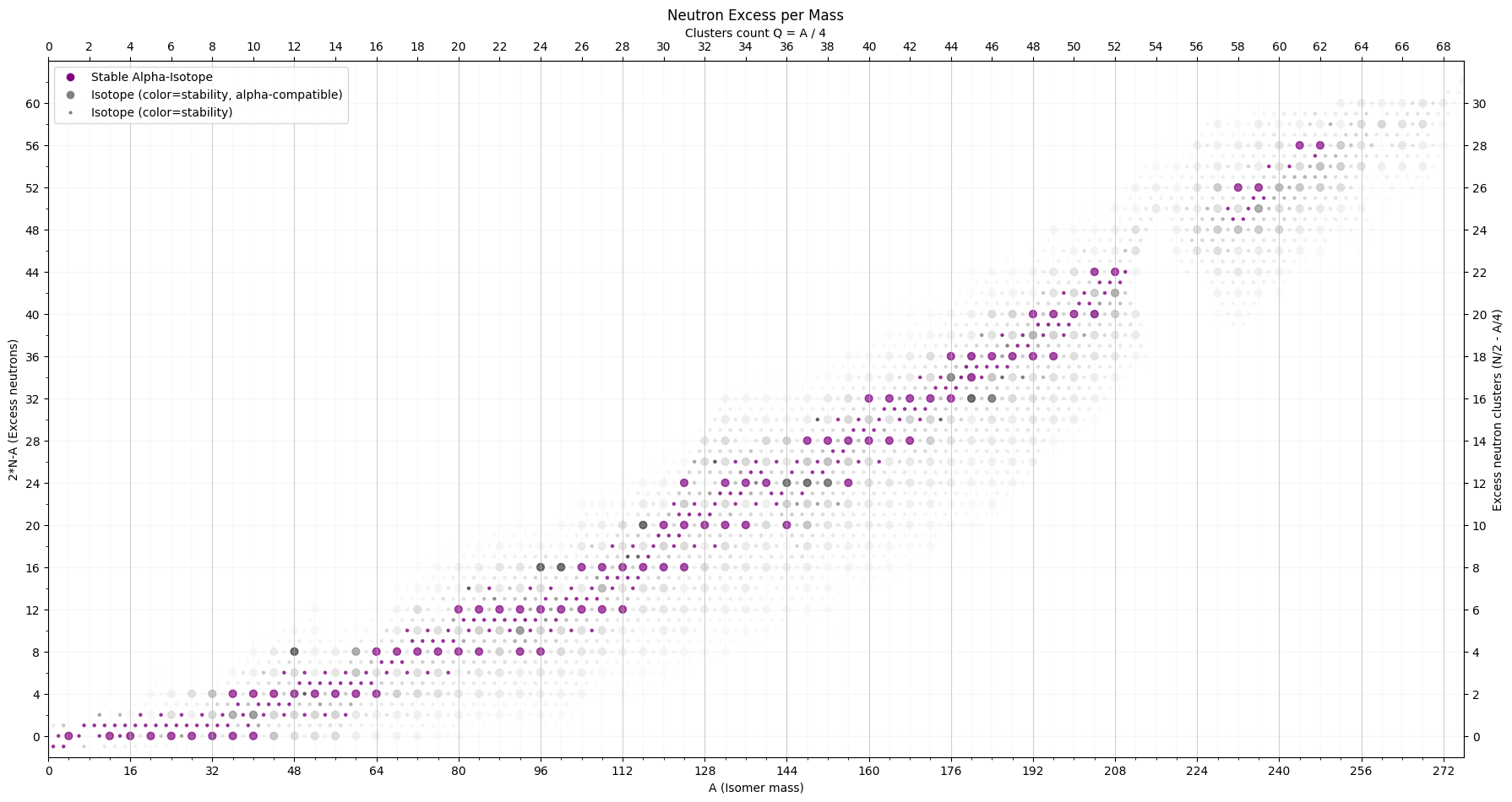
Figure – Excess-Nu-Clusters versus total Q-Clusters
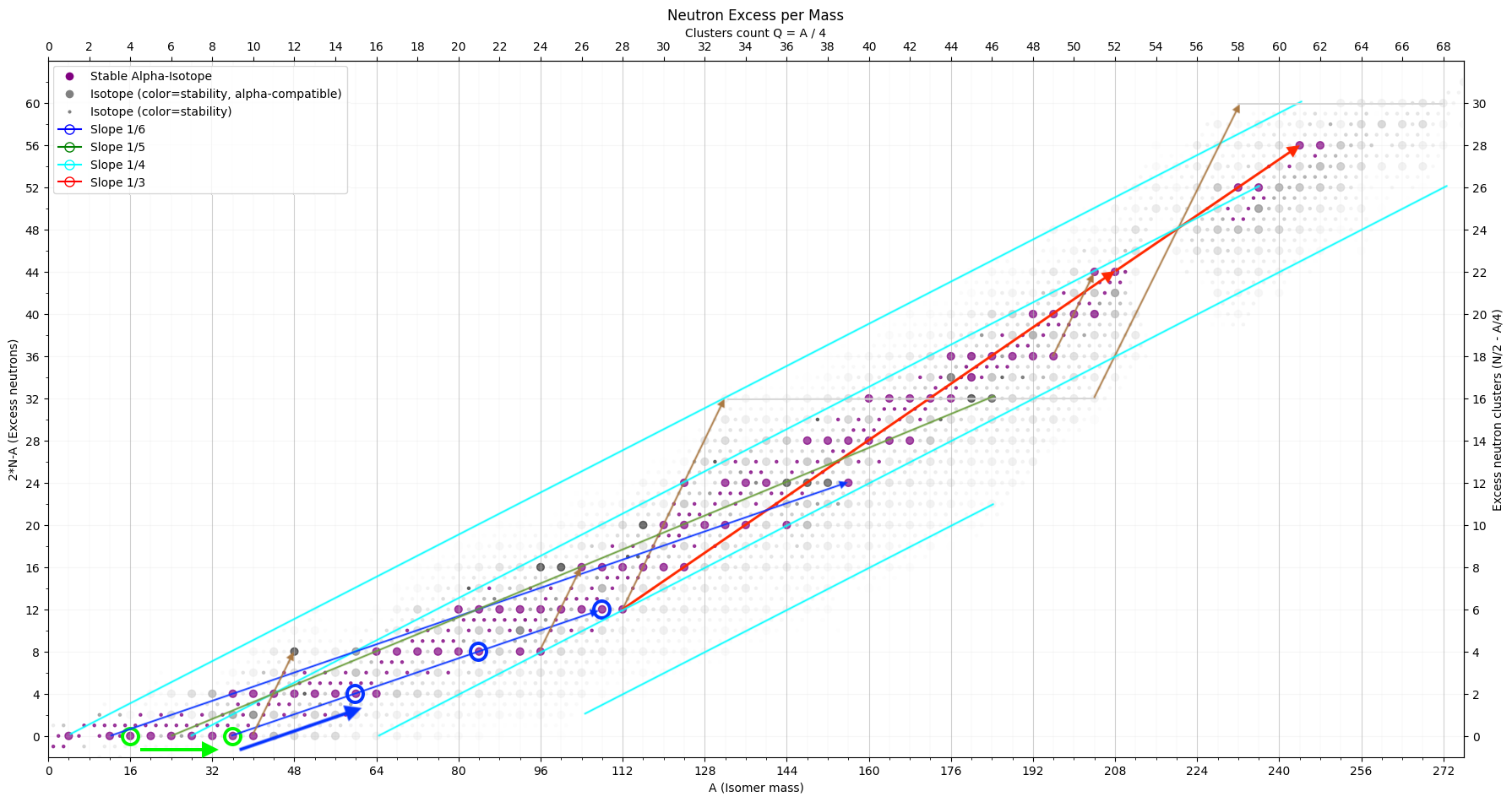
Figure – Excess-Nu-Clusters marked growth
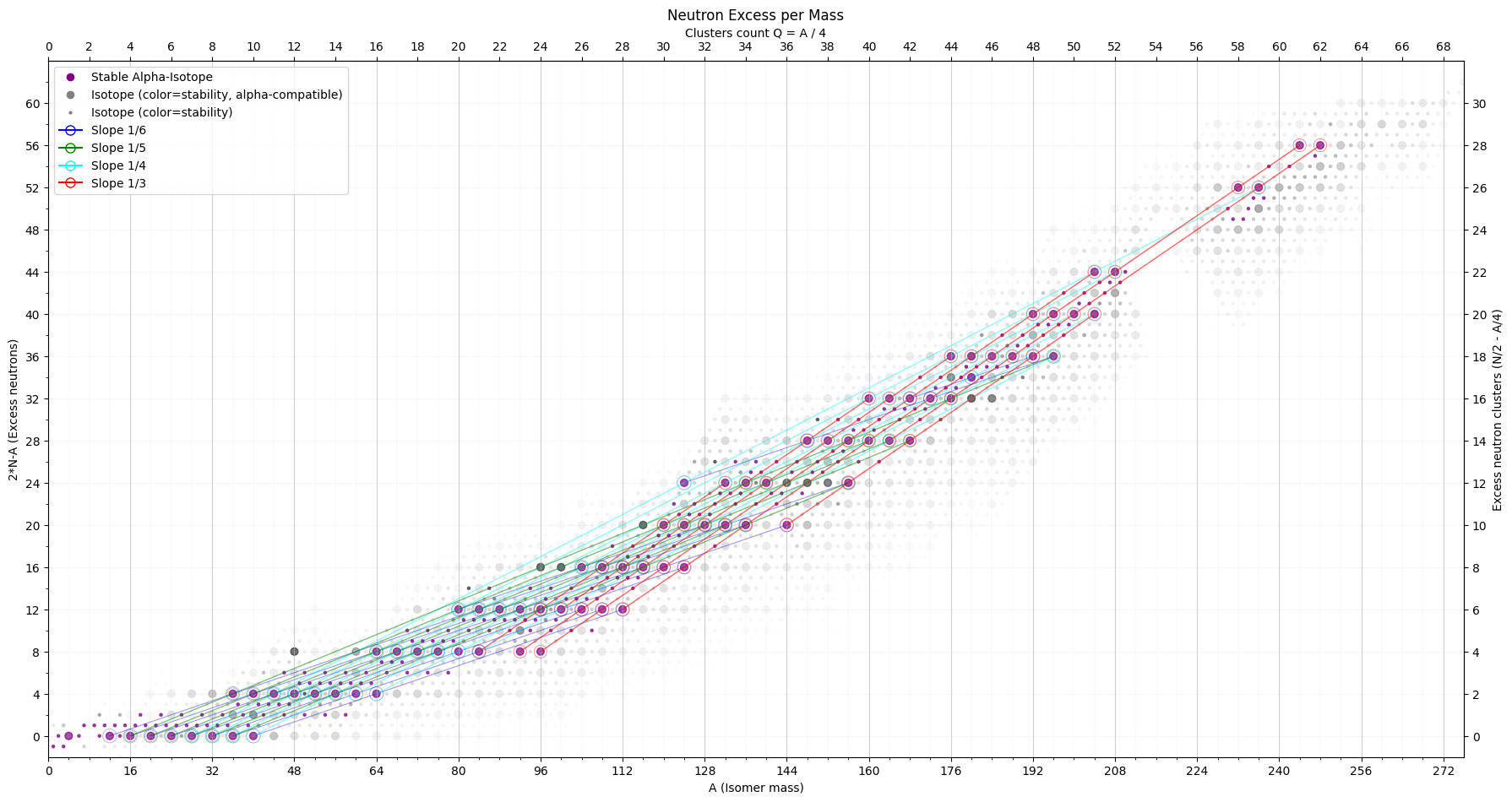
Figure – Excess-Nu-Clusters marked slopes
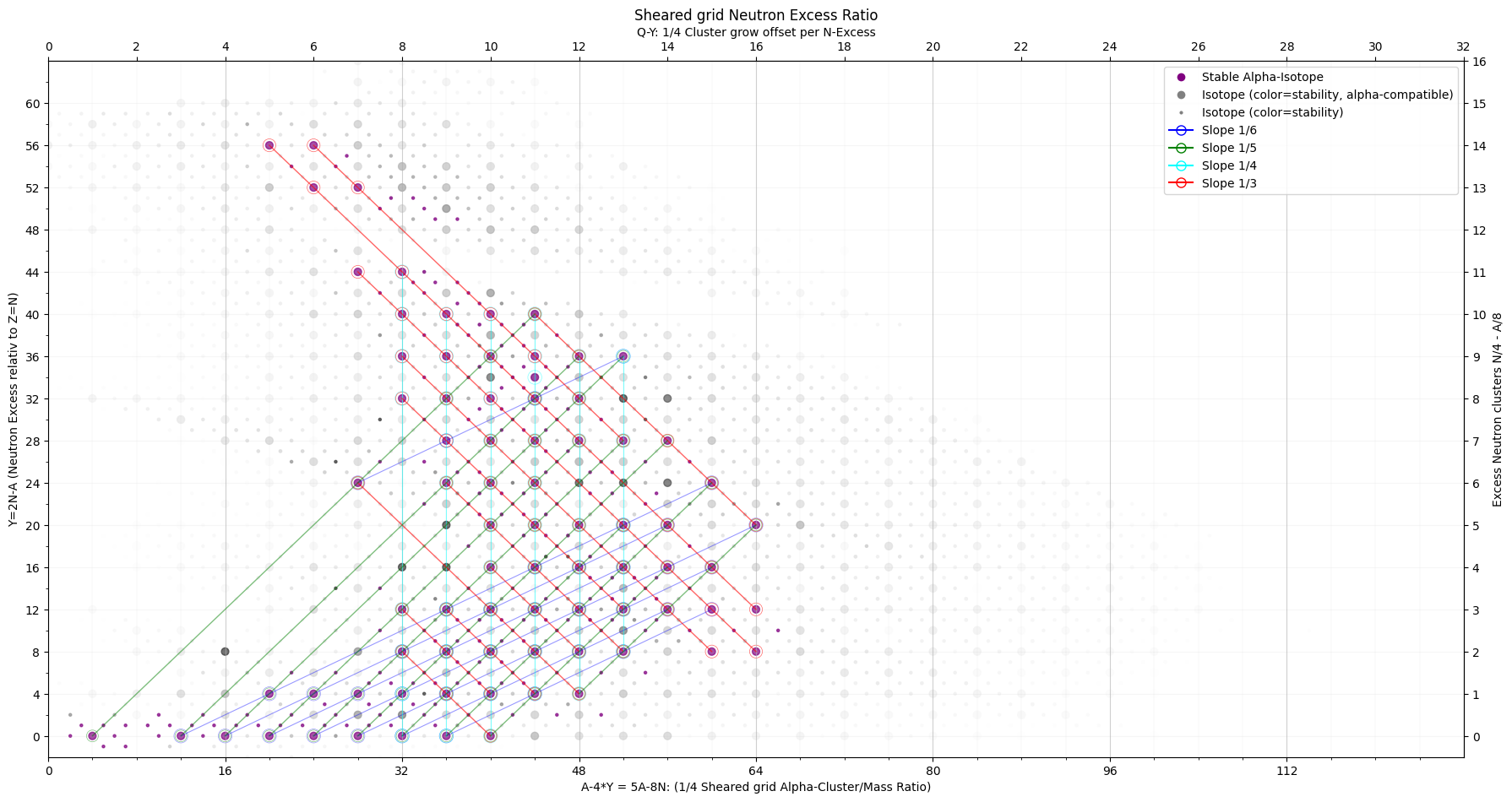
Figure – Excess-Nu-Clusters versus Q-Clusters sheared by 1/4
5. Role of Symmetry
Symmetry governs structural stability.
5.1 Axial Symmetry (dominant)
- determines primary stability
- strong violation → large energy penalty
- unpaired charge off-axis is unfavorable
5.2 Point Symmetry (fine structure)
- relevant for already stable nuclei
- related to deformation and quadrupole moments
5.3 Symmetry Aspects
Two distinct symmetry domains:
- mass symmetry → distribution of resonance units
- charge symmetry → distribution of charge-carrying nodes
Both affect:
- closure of resonance channels
- coupling to external fields
6. Charge and Occupation Structure
Structures are composed of:
- charge-centered clusters (proton-, deuteron-, alpha-like)
- neutral clusters (neutron-like, multi-neutron structures)
- mixed combinations (PN, PPNN-like)
Assumptions:
- proton-like and neutron-like units share geometry
- differ mainly by presence of central charge
- pure neutron clusters are less stable
- mixed clusters (especially PPNN-like) are more stable
Interpretation:
- proton-like units provide structural anchoring
- neutron-like units provide flexible filling
7. Symmetry and Parity
Key rule:
odd proton number → must be symmetrically compensated
Preferred placements:
- on symmetry axis
- in central position
Consequences:
- even proton numbers favored
- protons tend to appear in symmetric pairs
- asymmetric single charges are unstable
Multiple topological families might provide stable isotopes too, which can not easily change family.
Prediction:
- (1) Very every Mass A in x-direction, looking at Z in the y-direction there will be 1 isotop for odd A and a typical max of 2 isotopes for even A.
- Check: YES
- (2) We might see rare cases where 3 isotopes might emerge, when two symetric oposite Alpha-Like-Clusters have 0, 1 or 2 charges. Such NNNN sub-clusters might need to be fully embedded in the symmetry though to be stable. This might need a 20 shell extension with a frustration reduced 10 layer. We will then see a 30-Alphas cluster with a 0 or 1 center inlay (120+0e/1e) 2 more NNNN inlays
20+10+1 Cluster = 31 Cluster.
$-1p$ = 30 Cluster + Center Neutron, or center-Proton –> 123 +e+ center P=50,52,54
Check: Clear triple Isotopes are: A=96 (Zi, Mo, Ru), A=100 (Mo, Ru, Pa), A=124 (Ti, Xe, Te), A=130 (Te, Xe, Ba), A=136 (Xe, Ba, Ce)
Cluster-Count: 24, 25, 31, 34 Alphas
24= 20-Cluster + 4 center cluster
25= 20-Cluster + 5 center cluster
–> See separate chapter for isotope Family
8. Frustration (Geometric Tension)
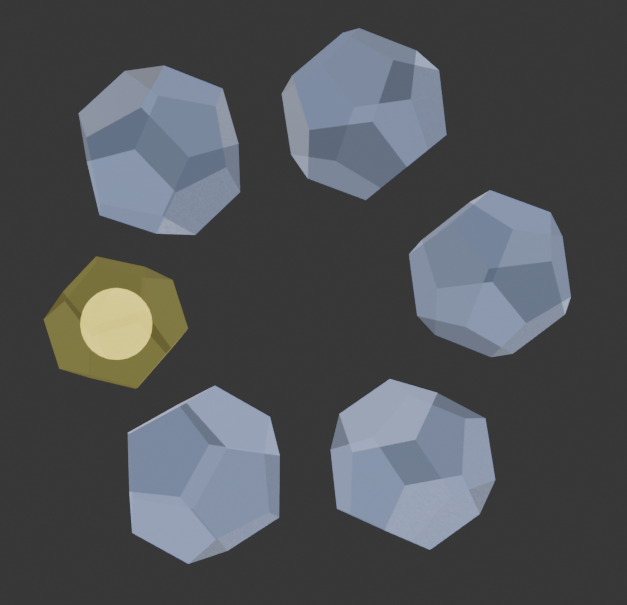
Figure – Frustrution Nu nodes
Not all ideal connections can be satisfied simultaneously.
Results:
- open channels (k < maximum)
- local stress
- competing configurations
Typical resonance levels:
$$
k \approx 3,\ 6,\ 9,\ 12
$$
These define structural quality.
Stable spatial configurations require triplet coupling of resonance units.
Isolated or weakly bound units tend to leave the system.
9. Limits of Pure Cluster Models
Pure cluster-based models are insufficient because:
- geometry cannot be perfectly filled
- not all channels can close simultaneously
- additional units (especially neutron-like) are needed
👉 Real nuclei are hybrid structures, not ideal cluster assemblies.
10. Dynamics and Transitions
Nuclear states evolve continuously:
$$
S_0 \rightarrow S_1 \rightarrow S_2 \rightarrow \dots
$$
Transitions involve:
- reconfiguration of local occupation
- shifts in symmetry axes
- redistribution of frustration
👉 Decay is a natural transition within the landscape.
11. Isotope and Isomer Landscape
The observed map consists of:
- deep minima → stable isotopes
- shallow minima → long-lived isotopes
- secondary minima → isomers
- transition paths → decay channels
Key observation:
- typically 1–2 optimal configurations per mass number (A)
- others are energetically inferior
Charge distribution constraints:
- odd Z → single central charge
- even Z → symmetric axial distribution
12. Competing Structures
For each $A$, multiple families compete:
$$
S^{(1)}, S^{(2)}, S^{(3)}, \dots
$$
Observed isotope:
$$
\min E(S^{(i)})
$$
Nearby states appear as:
- isomers
- metastable nuclei
- rare isotopes
🎯 Core Statement
The isotope map is not a set of isolated points, but:
a projection of a high-dimensional landscape of competing resonance structures, where only a few configurations are globally optimal and many others exist as local minima evolving toward lower-energy states.
🧭 Transition to Chapter 2
Based on this framework, the next step is:
- parameterizing structural families
- generating configurations
- defining transformation rules
👉 moving from concept → construction
Use the share button below if you liked it.
It makes me smile, when I see it.