PRELIMINARY SKETCH
Intro to energy
Is the term energy at all important in the LEDO-Model? How did it matter (hehe) so far? How do we see it now?
Energy Density Repulsion
We introduced the term “energy density” for different purposes.
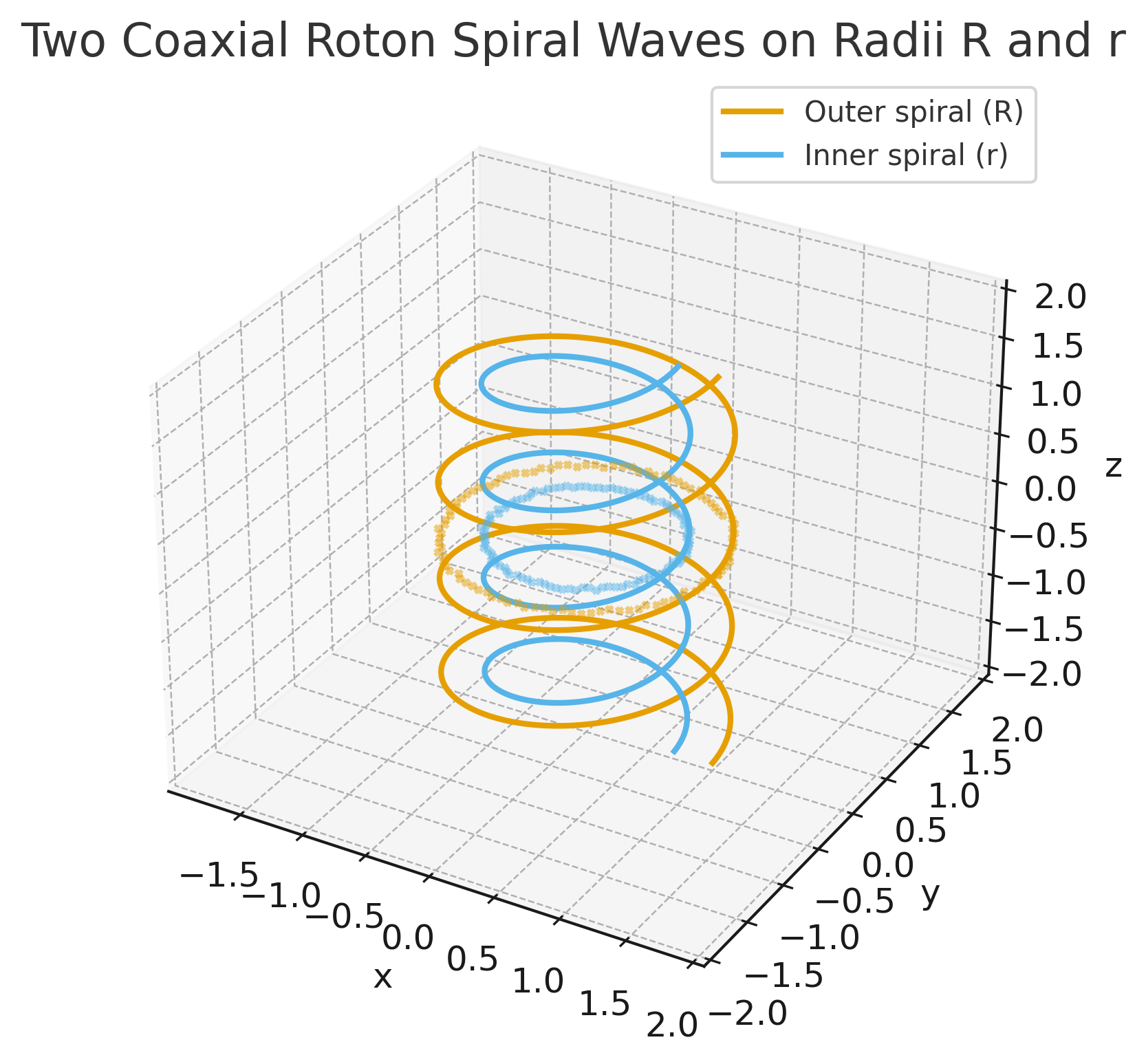
In this section we derive a compact coupling model for self-stable coaxial cylindrical (spiral) LEDO-waves, as they occur in the Roton-Model. We consider two Roton-spiral waves located on different ring radii, and compute how strongly the outer spiral wave can couple inward to the inner spiral wave. We also identify the geometric and frequency conditions for forward coupling, resonance, and the possibility of a backward-running component.
Conclusion:
Strong coupling of two Roton-Resonance waves requires nearly matching radii and small-integer resonance conditions. A backward-running LEDO component (repulsion) meight potentially become possible when the inner spirals frequency forms a specific periodic modulation.
A self-stable Roton spiral wave positioned on a ring of radius $R$ around the $z$-axis can be written in cylindrical coordinates $(\rho,\theta,z)$ as
$$ \Psi_R(\rho,\theta,z,t) = A_R, f_R(\rho), e^{i(m\theta + kz - \omega t)}, $$
where:
A Gaussian profile is convenient:
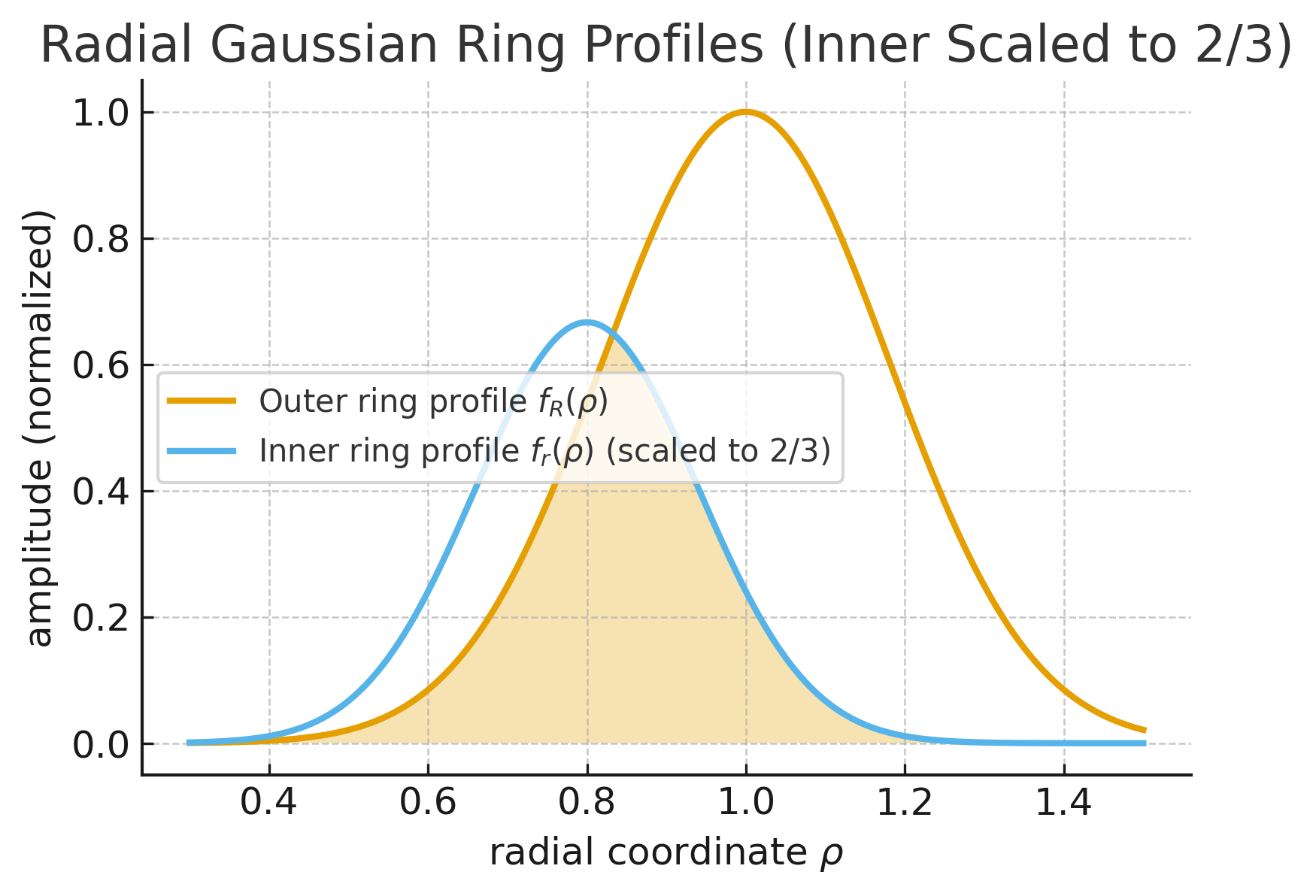
$$ f_R(\rho) = \exp!\left( -,\frac{(\rho - R)^2}{2\sigma_R^2} \right), $$
with $\sigma_R$ the radial “thickness” of the cylindrical wavefront.
A second Roton spiral wave on a smaller radius $r < R$ is modeled analogously:
$$ \Psi_r(\rho,\theta,z,t) = A_r, f_r(\rho), e^{i(m_r\theta + k_r z - \omega_r t)}, $$
with
$$ f_r(\rho) = \exp!\left( -,\frac{(\rho - r)^2}{2\sigma_r^2} \right). $$
The goal is to determine how strongly $\Psi_R$ couples into $\Psi_r$.
The natural definition of the coupling coefficient is the mode-overlap integral:
$$ K_{R\to r} \propto \int \Psi_R(\rho,\theta,z,t), \Psi_r^{!*}(\rho,\theta,z,t), dV , $$
with the cylindrical volume element
$$ dV = \rho, d\rho, d\theta, dz $$
Inserting the two spiral waves gives
$$ \Psi_R \Psi_r^{!} = A_R A_r^{!}, f_R(\rho) f_r(\rho), e^{ i[(m-m_r)\theta + (k-k_r)z - (\omega-\omega_r)t]} $$
Integration over $\theta$ and $z$ yields:
The remaining radial overlap integral is
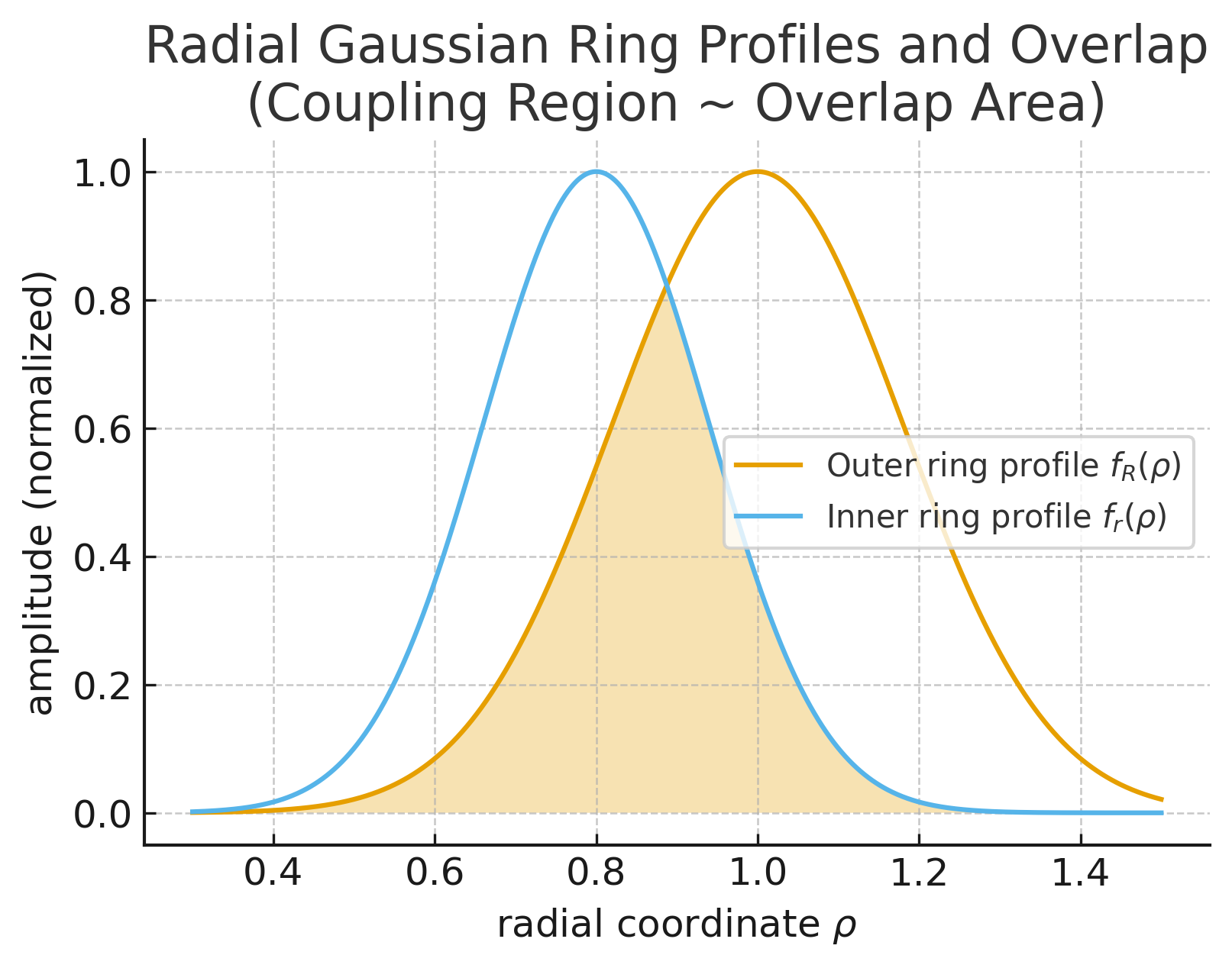
$$ I_\rho = \int_0^\infty \rho, f_R(\rho) f_r(\rho), d\rho . $$
For Gaussian ring-profiles:
$$ I_\rho \propto \exp!\left[ -,\frac{(R - r)^2}{2(\sigma_R^2 + \sigma_r^2)} \right]. $$
Thus:
$$ K_{R\to r} = K_0 , \exp!\left[ -,\frac{(R-r)^2}{2\sigma_{\text{eff}}^2} \right], F_{\text{res}}(m,m_r,k,k_r,\omega,\omega_r), $$
with $\sigma_{\text{eff}}^2 = \sigma_R^2 + \sigma_r^2$.
Significant coupling requires
$$ |R - r| ,\lesssim, \sigma_{\text{eff}}. $$
Typical assumptions ($\sigma_R \sim \sigma_r \sim 0.1R$) give
1. Temporal Resonance $$ \omega_R \approx \omega_r. $$
2. Azimuthal Resonance $$ mR \approx m_r r. $$
3. Longitudinal Resonance Forward: $$ k \approx k_r. $$
Backward: $$ k \approx -k_r. $$
If the inner spiral forms a periodic modulation of period $\Lambda$, define
$$ G = \frac{2\pi}{\Lambda}. $$
Backward scattering occurs if
$$ 2k_R \approx G, \qquad k_r \approx -k_R. $$
The coupling of coaxial Roton spiral waves is determined by radial overlap and resonance conditions:
$$ K_{R\to r} \sim \exp!\left[ -,\frac{(R-r)^2}{2\sigma_{\text{eff}}^2} \right] \cdot F_{\text{res}}(m,m_r,k,k_r,\omega,\omega_r). $$
Conclusion: Strong coupling requires nearly matching radii and small-integer resonance conditions. A backward-running LEDO component becomes possible when the inner spiral forms a periodic modulation satisfying $k_r \approx -k_R$.
Use the share button below if you liked it.
It makes me smile, when I see it.